

The first Friday we played Jaipur, Mark beat me by thirty rupees and then spent a quarter of an hour explaining why his camel strategy had been obvious from the start. I put the cards back in the box, told him we would play again the next week, and privately decided I would learn the market better than he had. That was three months ago. Since then the Asmodee two-player trading game has sat on our kitchen table almost every Friday night, plus a handful of Sunday afternoons on the back patio, and I have enough plays behind me now to tell you what holds up and what starts to wear thin.
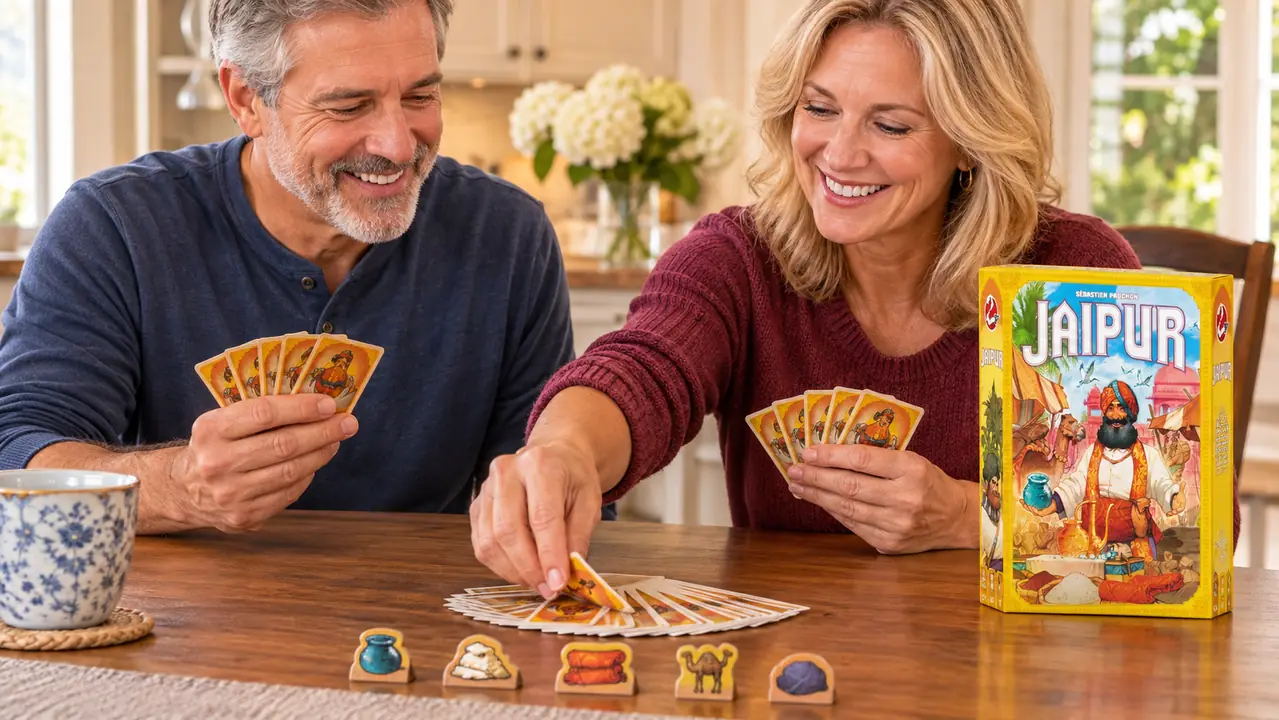
A word on scale first, because if you are shopping for a couple's game everything on the shelf looks like the same size box. Jaipur is small. Fifty-five goods cards, thirty-eight goods tokens, eighteen bonus tokens, one camel token, three seals, and a rulebook that runs a few pages. It is built for exactly two players, ages ten and up, and the box estimates thirty minutes. In our house a single round lands closer to twenty, and a full game, which is best of three rounds, usually takes us thirty-five to forty-five minutes because Mark likes to think.
The Quick Verdict
A tight two-player trading game that got better the more we learned it. Small box, short rounds, and just enough needling across the table to keep a Friday night awake.
Amazon Check Today's Price →The small-box game that earned a permanent spot on our table
Jaipur is two players, about thirty minutes, and a rulebook you can learn in one sitting. If your Friday nights have gone quiet, this is a low-risk way to fill them.
Amazon Check Today's Price on Amazon →How I've Used It
Our house went quiet in a specific way after our kids moved out. Not a sad quiet, just the quiet of two people who had spent two decades building evenings around other people's schedules and then suddenly did not have to. Mark manages HVAC service crews, so his days are loud and full of other people's emergencies. By Friday he wants to sit down and not think about a compressor. I taught middle school English for most of my working life, and I want something to do with my hands that is not folding laundry.
So we started Friday game nights. We tried a few things before Jaipur. One was too long, one turned every round into a negotiation about the rules, and one was competitive in a way that left the evening feeling like a chore. Jaipur was the one that stuck, and I think it stuck because the rules are small enough to hold in your head after two plays. Nobody has to be the rulebook person. Nobody has to look anything up halfway through. That matters more at fifty-six than it did at thirty.
We taught it to my brother-in-law and his wife over the holidays. It took about five minutes to explain and they were playing competently by the second round, which is the highest compliment I can give a rulebook. Nobody reached for the lid to check a rule. That almost never happens in our house.
Most weeks we play at the kitchen table with the radio on low, or out back when the evening cools off enough, which in Mesa means roughly October through April and not a day more. A full game fits between dinner and the dishes. That is the whole pitch, really. It fills a gap in the evening without taking the evening over.
What's in the Box and How a Round Works
The premise is that you and the other player are rival merchants in Rajasthan, buying and selling leather, spices, cloth, silver, gold, and precious gems. You earn rupees by collecting sets and cashing them in at the right moment. Cards sit in a market row in the middle of the table. On your turn you either take a card or sell a set, and you cannot do both. That single restriction is where all the tension lives, because every turn you spend taking is a turn you did not spend selling, and the other player is watching you build.
The tokens handle the scoring. Selling a set earns you tokens, and the earlier you sell a particular good the better those tokens are, because the pile runs down as the game goes on. I did not appreciate this until our sixth or seventh play. Early on I was just grabbing cards that looked useful. Later I understood that selling three spices in the first third of the round is worth more than selling five at the end, and that changed how I looked at the market entirely. Asmodee keeps the component list to a handful of items, which is why setup takes about ninety seconds and cleanup takes less.
The Camels Are the Whole Game
There is one camel token and a set of camel cards, and camels cannot be sold. What they do is let you take several cards in a single turn, which sounds like a small courtesy and is actually the engine of the whole thing. New players ignore camels because they do not score. Players who have lost a few rounds learn to respect them. I know, because I was the new player for five straight weeks.
Mark would quietly collect camels, wait for the market row to fill with two cards he wanted, then sweep the whole row in one turn while I sat there watching my options disappear. It took me an embarrassingly long time to see that a camel is not a slow card, it is leverage. Now I count them. I count the camels in his pile out loud sometimes, which he finds funny and I find necessary. The players who win in this house are the ones who spend two turns collecting and then one turn taking a pile of cards. New players spray cards around. Experienced players wait.
Camels cannot be sold, which is why new players ignore them, and why they decide who wins.
Three Months In: What Changed at Our Table
The first ten games were about learning the rules. The next ten were about learning each other, which is a different exercise entirely. Mark is a planner. He builds a hand and waits for the right moment. I am impatient and I sell early, which means I score steadily while he scores in bursts. By the second month we had both adjusted, and the games got closer and sharper.
The depth is not in the rules, it is in the timing. When do you cash in? Do you take the card you need, or the card he needs? There is a moment in a good round where you look at the row and realize the other player is one turn away from something, and you have to decide whether to spend your turn blocking instead of building. That is the whole game, and it has not gotten old at the rate I expected. We are somewhere north of forty plays and I still catch myself thinking about a round in the car the next morning.
What Weekly Play Actually Did for Us
I want to be careful here, because I have read enough of these write-ups to know when someone is overselling. Jaipur did not fix anything. Nothing needed fixing. What it did was give us a small, reliable thing to do together that is not television and does not require a reservation or a long drive. On a Friday when we are both tired, that is worth more than it sounds.
It also gives us a rivalry that stays inside the box. We needle each other about a card game for twenty minutes and then we eat dinner. There is a particular kind of fun in being allowed to be competitive with your spouse over something that does not matter at all. Thirty-one years in, most of what we disagree about matters. This does not. That is the point of it.
How It Stacks Up Against the Other Games in Our Cupboard
We have a shelf of two-player games now, because once Friday night became a habit we went looking. The ones that lasted are the ones with a short teach and a real decision in every turn. Jaipur sits in that group. It is not the deepest game on the shelf and it is not trying to be. What it has is a clean loop. Take a card, weigh the market, sell at the right moment, and try to read what the other person is building before they finish building it.
Compared with the bigger box games we own, Jaipur gets to the table far more often, because it does not require us to commit an entire evening or relearn a rulebook we last opened in March. Compared with the pure luck card games, it holds up far better over months, because the decisions actually matter. It is the game I would hand to a couple who has never bought a hobby game in their lives. It is also the game I would hand to a couple who has, and who wants something small and sharp for a Tuesday.
Where It Grates
Three complaints, and I will be straight about all of them. First, it is strictly two players. You cannot fold a third person in, so it is not the game you pull out when another couple comes over unless you want two people watching. Second, there is a luck element in the draw that bothers Mark more than it bothers me. You can play a clean round and still lose because the goods you needed never surfaced. It stings, and it happens often enough that I would not call this a pure skill game.
Third, the theme is thin. The premise is a marketplace in Rajasthan, but what you actually do is make efficient decisions about tokens. You do not feel like a merchant, you feel like a person sorting cards well. Some couples will not care about that at all. Some will, and if you are in the second group, this will read as a very good abstract game wearing a costume. I have made my peace with it because the decisions are good. Mark has not, entirely, and he mentions it roughly once a month.
What I Liked
- Small box, five-minute teach, and a ruleset you can hold in your head after two plays
- Rounds run about twenty minutes, so a full game fits between dinner and the dishes
- The camel rule creates real leverage and keeps the market tense right to the end
- Built for exactly two, which means no waiting around for a fourth player
- Set collection and hand management give it more staying power than most small-box games
Where It Falls Short
- Card draw luck can decide a round even when you played well
- The Rajasthan theme is thin once you are past the first few plays
- Not playable with a third person, so it does not scale for guests
- Some rounds end before the market gets interesting
Who This Is For
Couples who want a thirty-minute table game with a real decision in every turn. It suits pairs who have played a few hobby games and want something with teeth, and it suits pairs who have never played anything past a deck of cards, because the teach is genuinely short. Mark and I are not serious gamers by any measure and we had it inside two sittings. It is also a good fit for a parent and an older child, since the box says ten and up.
One more group worth naming: couples with a cabin weekend or a long drive coming up. The box is small, the tokens are sturdy, and it does not need a table the size of a door. We took ours to a rental near Prescott in the spring and played on a coffee table that was barely wide enough.
Who Should Skip It
If you need a game for four, this is not it, and no amount of clever play changes the player count. If a lopsided loss to a bad draw ruins your evening, the luck will get you eventually, probably on a night you wanted to win. And if you need theme to stay engaged, if you want to feel like you are standing in a market rather than looking at a row of cards, this will feel like a well-built puzzle rather than a story. Asmodee made a tight, honest design here. It just is not for every table.
Three months in, it is still the game on our table
If your Friday nights need a small, reliable thing to do together, this is the one I would hand you. Two players, about thirty minutes, and enough timing decisions to keep you both paying attention.
Amazon Check Today's Price on Amazon →