
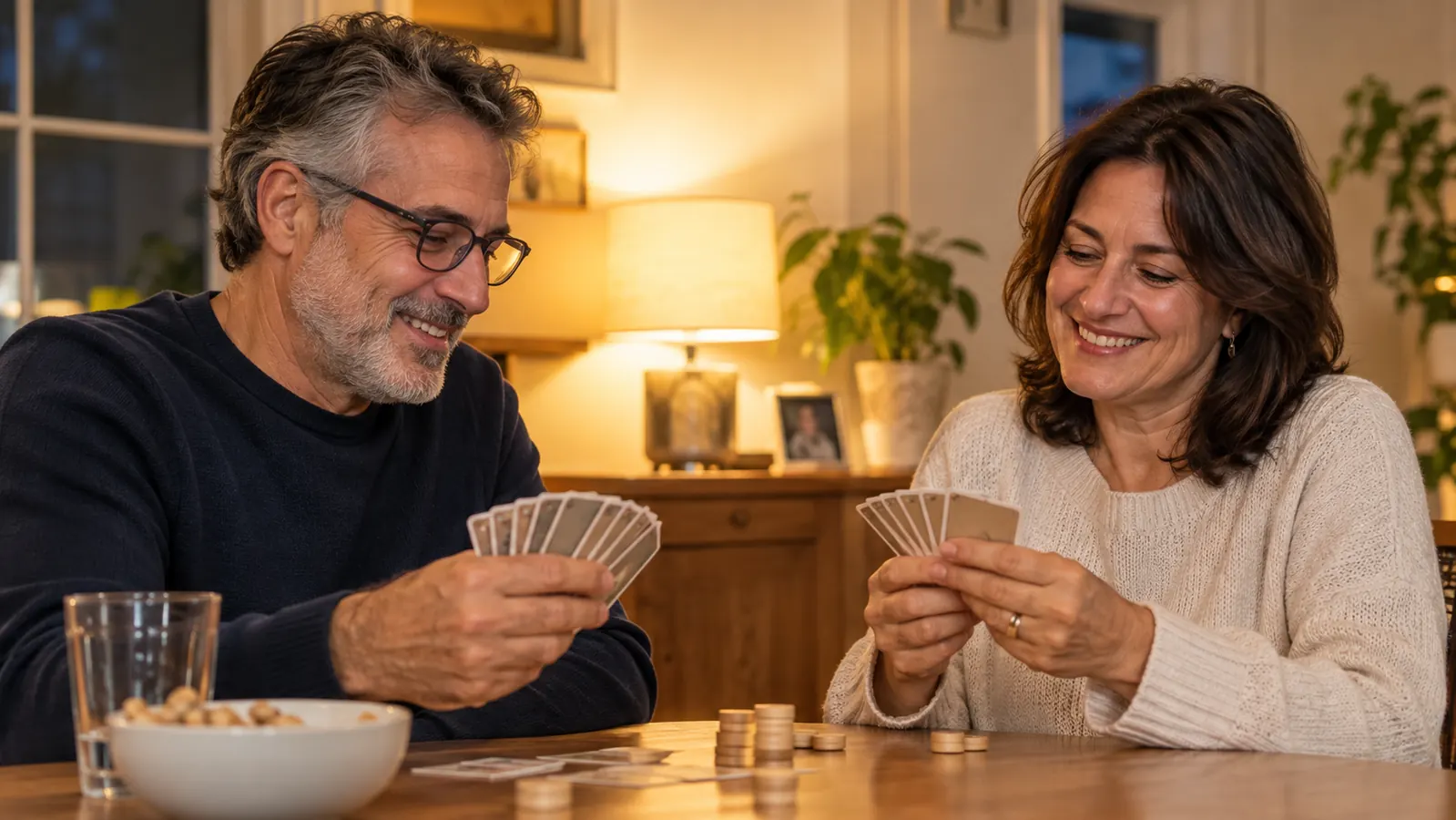
Friday night used to be a negotiation at our house. Mark would come home from a week of service calls, I'd be wiping down the counter, and one of us would ask the question neither of us wanted to answer out loud. What do you want to do? Most weeks the answer was television, and by nine o'clock we were both asleep in our chairs with the credits rolling.
Then our youngest moved out, and the house got quiet in a way that made the quiet feel like something to fill. I bought a copy of Asmodee Jaipur on a whim, mostly because the box said two players and thirty minutes and I liked the honesty of that. Three years of Fridays later, it is still the game that comes out first. Here is what I have learned about why a small two-player card game works better for us than a reservation or a movie.
Thirty minutes, two players, and no screens: see what Jaipur costs today
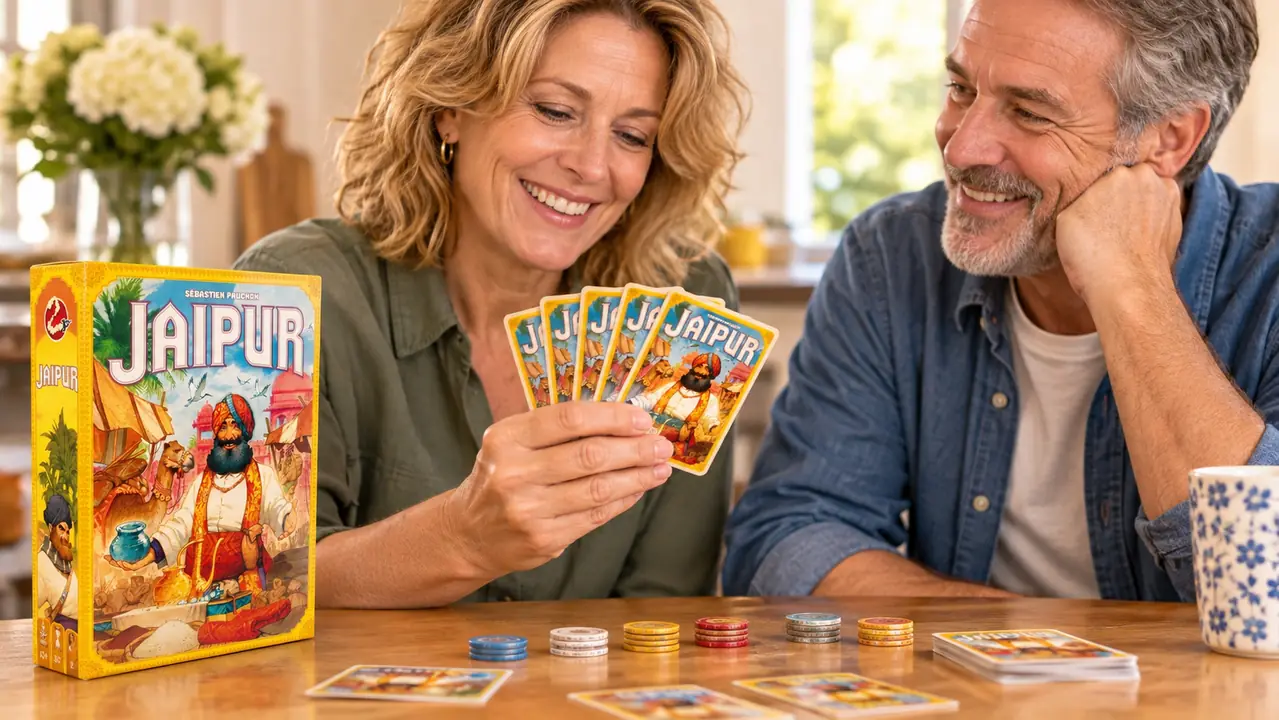
The version we keep on the shelf. Built by Asmodee for exactly two players ages 10 and up, with 55 Goods cards, 38 Goods tokens, 18 Bonus tokens, and one camel.
Amazon Check Today's Price on Amazon →It fits in the gap between dinner and the dishes
Jaipur lists a playing time of 30 minutes, and in our kitchen that number is honest rather than hopeful. We clear the plates, deal, play a full round, and still finish before the news starts. A game that asks for three hours needs a night cleared on the calendar and a decent night's sleep traded for it. This one just needs the table wiped down. That gap between dinner and dishes is where most weeknights go to die, and this is the thing that fits in it.
It is built for exactly two, so nobody is filling a chair
A lot of games sold as couple games are really party games with a lower player count printed on the back. Jaipur is the reverse. Two players, ages 10 and up, no third seat, no dummy hand, no house rule required to make it work with a pair. When Mark wins, he won because he read the market better than I did. There is nowhere to hide and nobody else to blame, which turns out to be a healthy thing to have in a marriage that is old enough to be comfortable.
The camel token gets a laugh every single time
One camel token comes in the box, and it does more for the mood at our table than any rule in the booklet. Camels are the goods nobody pays you directly for. They clog your hand, they sit there taking up space, and then, timed right, they pay out in a bundle. So one of us ends up holding a pile of camels and pretending it was the plan all along, and the other one laughs at the performance. Thirty-one years in, being funny at the kitchen table still counts for something.
You can teach it in one round, not one evening
I taught middle school English for 27 years, so I have opinions about instructions. Jaipur's rules fit on a couple of cards. Take goods, or sell goods, and the camels behave differently than everything else. We taught our neighbor on the back patio in about five minutes, and she beat Mark on her second round. Games you have to study before you are allowed to enjoy them do not survive a tired Friday. This one you can play badly on the first night and still have a good time.
The market row makes you watch the other person
A small market sits in the middle of the table, and what you take changes what is left for them. So you are not only playing your own hand, you are reading a face across the table. I know Mark is going for gold when he stops talking. He knows I hoard spices. It is a low-stakes way of paying attention to somebody that has nothing to do with who took out the recycling or who forgot to call the plumber. I notice him more in thirty minutes of this than in a whole evening of television.

Set collection gives you something to needle each other about
The game runs on hand management and set collection. You are gathering leather, spices, cloth, silver, gold, and precious gems, and the tokens for each one run out as the game goes. When Mark takes the last gold token I had been counting on, he knows exactly what he did, and he does not look sorry about it. That kind of gentle trouble is the fun part. It is competition without an argument, and we can be laughing about it ten seconds later.
There is no board to set up or put away
The whole thing is 55 Goods cards, 38 Goods tokens, 18 Bonus tokens, one camel token, and the seals. No board, no miniature figures, no separate deck per player. We play on the back patio with a glass of something and one light on overhead. Setup takes under a minute and teardown is faster. That sounds like a small thing until you notice that the games which stay in rotation are the ones you will actually bother to get out on a night when you are both a little tired.
It ends before anybody gets tired or cranky
There is a real difference between a game that winds down and one that collapses. Jaipur has an end condition and it arrives. You play out the round, somebody takes it, and you both still like each other. We have a rule now, which is that we stop while it is still fun. Ending on a good round beats squeezing in one more and finishing the night irritated over a stack of tokens. You would be surprised how many date nights go wrong at the very end for no good reason.
Three rounds turn it into a small tournament
The box includes three seals, and taking a round earns you one. Two seals and the match is yours. That structure is why it does not feel thin after a few dozen plays. Each round resets the goods and the market, momentum swings hard, and a deciding round carries real weight for something that takes half an hour. We have had final rounds at our table that were quieter than the rest of the week. It costs nothing but twenty minutes to find out who is sharper that night.
It gives you something to talk about that is not the schedule
Here is the plainest reason I keep recommending this game to friends our age. It replaces the default. Instead of two people in the same room looking at different screens, you get thirty minutes sitting across from each other doing something small together, with a little teasing and a little thinking involved. Nobody has to be profound and nobody has to plan a conversation. The talking just happens, because you are both there and you are both paying attention.
What I'd Skip
Two things to be straight about before you order anything. Jaipur is competitive, so if one of you needs games where nobody loses, this is not that game. Somebody takes the round. That is the entire point, and the losing half of the couple will feel it. Second, this is a card game with tokens, not a conversation deck. It will not hand you questions to ask each other about your childhood or your five-year plan. It gives you something to do side by side and the talking grows out of that. If what you actually want is a stack of prompts, buy a stack of prompts, and buy this one for the night you want to play something instead.
Setup takes under a minute and the whole thing stores in one box. The games that stay in rotation are the ones you will actually bother to get out on a tired Friday.
One small box, two people, thirty minutes, and a Friday worth staying up for
Asmodee built Jaipur for exactly two players ages 10 and up, with 55 Goods cards, 38 Goods tokens, 18 Bonus tokens, and a playing time of 30 minutes. It is the one that keeps coming back out at our table.
Amazon Check Today's Price on Amazon →