
For most of our marriage, the television was the third person at dinner. Mark would come in from a day of service calls, I would finish the dishes, and by 7:30 we were both on the couch watching something neither of us could have described the next morning. Thirty-one years married. Two kids grown and gone. A living room that had gotten quiet in a way I did not know how to name, and a growing suspicion that what we needed was smaller than a vacation. A game, maybe. Something with cards in it, from a company called Asmodee, that I could leave sitting out on the counter.
The quiet is what got me. For a few months after the last kid moved out we just sat in it. Then I started noticing that our only real conversation all week was about the HVAC schedule or whether the orange tree needed water. I spent most of my working life in a middle-school English classroom, so I know a little about getting reluctant people to talk to each other. I had just never applied any of it to my own kitchen table.
We tried the usual things first. A puzzle that sat half finished on the dining table from March to July. A deck of conversation cards that got so earnest so fast that Mark started reading the questions in a game show voice. A couples game we bought on a whim that turned out to be mostly arithmetic. What I wanted was small. Something I could leave on the counter, and something he would actually ask for again.
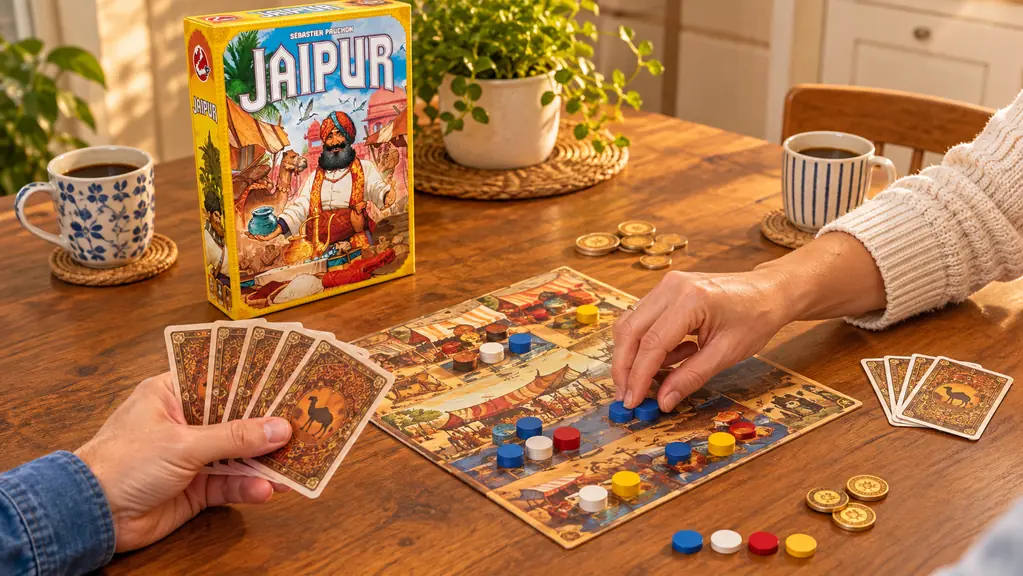
That is how Jaipur ended up in our house. Asmodee publishes it, and I had walked past the name a dozen times in the game aisle without registering it. The box says ages 10 and up, two players, about 30 minutes. The two players part is what sold me. No empty chair. No waiting on a fourth. Just the two of us and a rulebook thin enough to read standing up.
You are a merchant in Rajasthan. There are 55 goods cards and a market row you draw from, plus 38 goods tokens, 18 bonus tokens, one camel token, and three seals. On a turn you either take a card or sell a set. Leather, spices, cloth, silver, gold, precious gems. Camels let you swap several cards at once. Sell three or more of the same good and you claim a token. The seals decide who takes the match.
We played four rounds that first Friday and the television never got turned on. Not once. Nobody announced a date night.
The game we now keep on the counter instead of in the closet
Two players, about 30 minutes, one thin rulebook. If your evenings have gotten quiet, this is a low-risk place to start.
Amazon Check today's price on Amazon →Here is what surprised me. Jaipur is not a talking game. There is no prompt card, no question to answer, no forced vulnerability. What it does instead is give two people something to think about side by side. Mark is quiet by nature and he does not volunteer feelings. But he will absolutely argue about whether I should have taken the camel.
The Asmodee rulebook is short enough that I read it once and explained it to him in about four minutes. By the second round we were not checking anything. That matters at our age. If I have to spend an evening learning a game, we are not playing it on a Friday after he has been on a roof all day.
There is luck in it. Sometimes the market row hands you exactly what you need and sometimes it hands your husband exactly what he needs, and you will both know it. I do not mind. It keeps the game from feeling like a test I am failing. The decisions still matter. Selling early for a modest token is often smarter than holding out for the big one, and learning when to do each is most of the game.
The tradeoff is real, though. It is two players and only two players, so it is no good for a group or for a family night with company. It is also a game you can lose to a bad draw, and if you are someone who needs every loss to be a fair measure of skill, that will bother you. Mark is the competitive one in this house and he has never once complained, which tells you something.
The pieces hold up. After a year of Fridays nothing has frayed and nothing has gone missing except one token that turned up under the placemat. It packs into a box about the size of two paperback books, which is why it goes out to the patio in summer and to my sister's house at Thanksgiving.
What I'd Tell You If We Were Sitting at My Kitchen Table
I would tell you not to buy a game expecting it to fix anything. A card game is not a counselor and I would not insult you by pretending it is. What I would tell you is that a week needs a few small rituals in it, and for 31 years ours were mostly built around the kids. When the kids left, the rituals left with them. Jaipur is not a rescue. It is a thing to do at 7:30 on a Friday that is not a screen.
I would also tell you to give it three rounds before you decide. The first round of any new game is mostly rulebook and second-guessing. The game shows up in the second and third, when you start noticing what the other person is collecting and adjusting your own plan to cut them off. That is the part I like. It is not a conversation about feelings. It is a conversation, and after 31 years I will take it.
Thirty minutes at the kitchen table beats three hours of nothing on
Two players, ages 10 and up, about 30 minutes a round, from Asmodee. Keep it on the counter where you will actually reach for it.
Amazon See the Jaipur listing on Amazon →