

I bought Jaipur because the box was small and the shelf was full. That is the whole reason. I did not watch a video, I did not read a review, and I did not know that Asmodee had been quietly selling this two-player trading game for years to couples who wanted a card game that did not arrive with a rulebook the size of a magazine. What I found at my own kitchen table in Mesa, on a Friday in late September with the ceiling fan clicking overhead, was a game that plays in about 30 minutes and asks you to pay attention the entire time. Every review I read afterward talked about how charming it was. Nobody mentioned the attention part, so I will start there.
Short answer first, since that is what I want when I read one of these. Jaipur is worth the money for couples who like a game with a little teeth and no shouting. It is a weaker fit for couples who want to talk their way through Friday night, because this game will not let you. Below is the long version, including the cons I would want to know about before I cleared a shelf for it.
The Quick Verdict
A sharp, quiet two-player trading game that rewards attention and punishes small mistakes. Right for a focused Friday, wrong for a chatty one.
Amazon Check Today's Price →Two Players, Thirty Minutes, No Rulebook Marathon
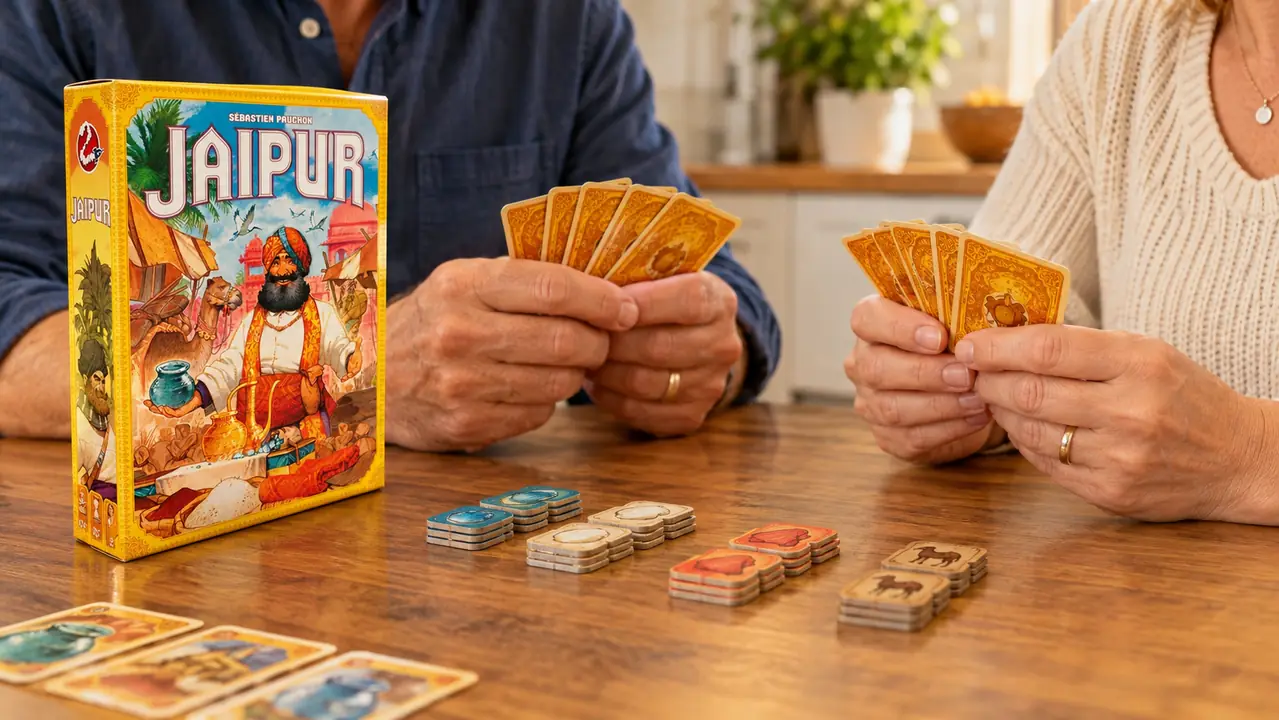
Jaipur is 55 goods cards, 38 goods tokens, 18 bonus tokens and one camel token. That is the entire footprint of your Friday night, and it sets up in under two minutes.
Amazon Check Today's Price on Amazon →What Nobody Tells You About Jaipur
The first thing nobody tells you is that Jaipur is mostly a game about refusing things. On your turn you either take one card from the market laid out in the middle of the table, or you take the row of camels, or you sell. That is it. Three choices. And yet every card you pick up is a card Mark cannot use, which means the whole game is one long, polite argument about what he is probably collecting. By the second round you are reading his hand like a weather report.
The second thing nobody tells you is that the tokens are the score, not the cards. You can sit there holding six spice cards feeling wealthy and lose the round anyway, because the money in Jaipur comes from selling at the right moment, not from hoarding. The 38 goods tokens and 18 bonus tokens are the real board. The cards are just the argument you have with yourself about when to cash in. I lost four Fridays in a row before that landed. Mark figured it out in week one and was gracious enough not to mention it until I asked him how he kept beating me.
The third thing is the one that decides whether this game belongs in your house. Jaipur is quiet. Not silent, but close to it. There is no phase where everybody laughs, no card that makes somebody tell a story about their childhood. It is two people looking at five cards and thinking. If that sounds like your idea of a good evening, keep reading. If it sounds like homework, you already have your answer and you can save yourself the shelf space.
How I've Used It, and How It Holds Up
Mark is 58 and manages HVAC service crews, so his week is loud and full of other people's emergencies. By Friday at 7:30 he does not want a game that asks him to read flavor text out loud to me. Jaipur asks him to look at five cards and make one decision. That is the right size of ask for him at the end of a week, and it has stayed the right size through about a year and a half of fairly regular play, mostly at the kitchen table and sometimes out on the patio once the evenings cool off.
The box has held up better than I expected it to. The cards are the part that wears, and ours show it: soft edges on the camel cards and a slight bow in the gold cards, because gold gets picked up more than anything else in the deck. Nothing has torn. The tokens have kept their print and their edges. I moved them into a small zip bag, because the insert in our copy never sat flat again once the punchboard was empty. The whole game weighs 231 grams, which means it goes into a tote bag and I never notice it is in there.
Setup takes less than two minutes. Shuffle, lay out the market, deal. That sounds like a small thing until you count how many games you have abandoned because starting felt like a chore. We have never once skipped Jaipur because it was too much work to get to the table, and I cannot say that about the larger boxes on our shelf. The Asmodee rules sheet is short enough that I have never had to look anything up mid-game, which after thirty years of marriage is its own kind of gift.
Nothing about Jaipur is complicated. Everything about it is a decision. That is a rare combination in a small box.
Camels Decide More Rounds Than You Think
There is one camel token and a row of camel cards, and at first glance they look like a joke the designer left in the box. They are not. Camels let you swap. You can take a pile of them early and then trade them back two at a time for the cards you actually want, which makes the camel row a bank you can raid when the market turns ugly. Mark plays camels aggressively. I played them carelessly for a month and could not work out why my hand was always one card short of a sale.
The other thing the camels do is create pressure without conflict. Nobody attacks anybody in Jaipur. There is no take-that card, no stealing, no rule that costs your spouse a turn and makes them sulk. You compete by taking what is on the table before he does. For couples who do not want to be irritated with each other at nine o'clock at night, that is a real feature, and I do not think it gets said often enough in the reviews that call this game a classic.
Where It Gets Thin
Honest cons now. Jaipur is built for exactly two players and there is no version of it for three or four. If your Friday sometimes includes another couple, or a grown kid who drove in for the weekend, this is not the game you reach for. Somebody sits out with a mug and watches, or you split into pairs and play two separate games, and neither arrangement is as good as the two of you at one table. That is not a flaw exactly. It is a limit, and the box tells you about it plainly.
Second, the luck is real and it is not handed out evenly. Cards come off a shuffled deck. Some rounds open with leather and gems sitting on the table, and some rounds open with cloth that neither of us wants. Over twenty games the better player wins more often, and I believe that. Over one game, a bad draw can decide the whole thing. Mark and I have both had rounds where one of us clearly played better and lost, and in a game this tight that stings more than it would in something looser.
Third, and this is the one that matters for date night: Jaipur does not get you talking. It gets you thinking. There is a difference, and you know it if you have ever finished a game and realized the only words you said for half an hour were your turn and nice one. That can be a lovely half hour. It is not a conversation, and I would not want you to buy this expecting one.
Fourth, what is in the box is what you get. Three seals of excellence, the tokens, the cards, the rules. There is no second deck to add and no variant that changes the shape of the game. Somewhere around your fortieth play you will know the rhythm well enough that the tension comes from reading your partner rather than from discovering anything new. For us that is fine, because the reading part is the fun part. If you need a game to surprise you every single time, this one will not.
What I Liked
- Designed for exactly two, so nobody is the spare wheel
- About 30 minutes a game, which fits an actual weeknight
- Camels create real decisions without any take-that conflict
- Sets up in under two minutes with no rulebook rehearsal
- Small and light at 231 grams, so it travels in a tote bag
Where It Falls Short
- No three or four player option at all
- Market luck decides some rounds outright
- Quiet game that competes with conversation rather than feeding it
- Card edges soften with steady play
- The insert does not hold the tokens once the punchboard is empty
The Age Range Nobody Explains
The box says 10 and up, and I taught middle school English for nearly thirty years, so I have opinions about that number. Ten is about right for the reading, which is almost nothing, and about right for the patience, which is the real requirement. A ten-year-old can hold the three choices in their head and make a plan. What a ten-year-old often cannot do is lose a close round without it ruining the evening, and Jaipur produces close rounds. Play it with a grandchild who is a good sport. Wait a year with one who is not.
For adults, the ceiling is higher than the box suggests. The rules fit on a couple of cards, but the play is not shallow. Card drafting, hand management and set collection is how the listing describes the mechanics, and in practice it means: know what your partner is collecting, sell before he does, and keep enough camels in reserve to fix a bad market. That is enough to think about for years without ever feeling like you need to read a forum thread to keep up.
How It Sits Next to the Games We Already Own
Our shelf has the usual two-player suspects on it, and Jaipur has quietly pushed most of them to the back. The games we stopped reaching for were the ones that needed a fifteen-minute refresher every time, or the ones where one person clearly had the upper hand after three plays and neither of us wanted to say so out loud. Jaipur does not have that problem. The skill gap between Mark and me has stayed small, and a small gap is the thing that keeps a box coming back out of the drawer month after month.
If you have been circling the idea of a two-player game for a while and everything you looked at felt either too light to hold you or too much like a hobby to keep up with, this sits right in the middle. That middle is a narrow place and not many games live there. I would put it ahead of the pretty deck builders I bought and abandoned, mostly because I can explain Jaipur to a guest in three sentences and be actually playing a minute later, which is what I want on a Friday.
Who This Is For
This is for couples who want a shared thirty minutes where neither of them is holding a phone. It is for the pair who have worn out the obvious two-player card games and want something with a little more edge but no cruelty. It is for the couple who travel and want a game that goes into a carry-on without a negotiation. Mark and I are thirty-one years in, our kids are grown and gone, and this is the box that comes out when neither of us has the energy to be taught something new.
It also suits mixed experience levels better than most games I own. I am the reader in this house and Mark is the one who sees patterns in numbers, and after all this time we are close to even. Asmodee built a game where being clever helps but does not guarantee anything, and that is the reason it stays on our table instead of going into the donate bag with the rest.
Who Should Skip It
Skip it if your game night regularly has more than two people at the table. Skip it if what you want from a date night is a long conversation with a game in the background, because this game refuses to stay in the background. Skip it if losing to your spouse on a lucky draw would follow you into Saturday morning. And skip it if you want a game that keeps revealing new rules to you over months. Jaipur shows you everything it has in the first two rounds and then asks you to play it better than you did last time.
There is one more group I would steer away, gently. If you are buying this hoping a card game will loosen up a quiet marriage and get the two of you talking again, a card game is not the tool for that job. Jaipur is a good game. It is not a counselor, and no box on a shelf is one. Buy it because you want to play something together, not because you want it to do work that a game cannot do.
What I'd Tell You Over Coffee
I would tell you that the reviews calling Jaipur a classic are not wrong, and I would also tell you that classic does not mean right for everybody. What I like is that it respects my time. Thirty minutes, no setup ritual, no rulebook, and a real decision on almost every turn. What I do not like is that it takes my attention off Mark for those thirty minutes, and sometimes that is exactly what I want after a long week and sometimes it is the last thing I need.
So here is the question I would leave you with. When you picture Friday night at your own table, are the two of you talking, or are you solving something together? If it is solving, buy Jaipur and do not think about it again. If it is talking, put the money toward a conversation deck and come back to this one later, on a night when quiet sounds less like distance and more like a gift.
Thirty Minutes, Two Players, One Small Box
If quiet and sharp is what your Friday needs, Jaipur is the one I would hand you across the table. 55 goods cards, 38 goods tokens, 18 bonus tokens, one camel token, ages 10 and up.
Amazon Check Today's Price on Amazon →