
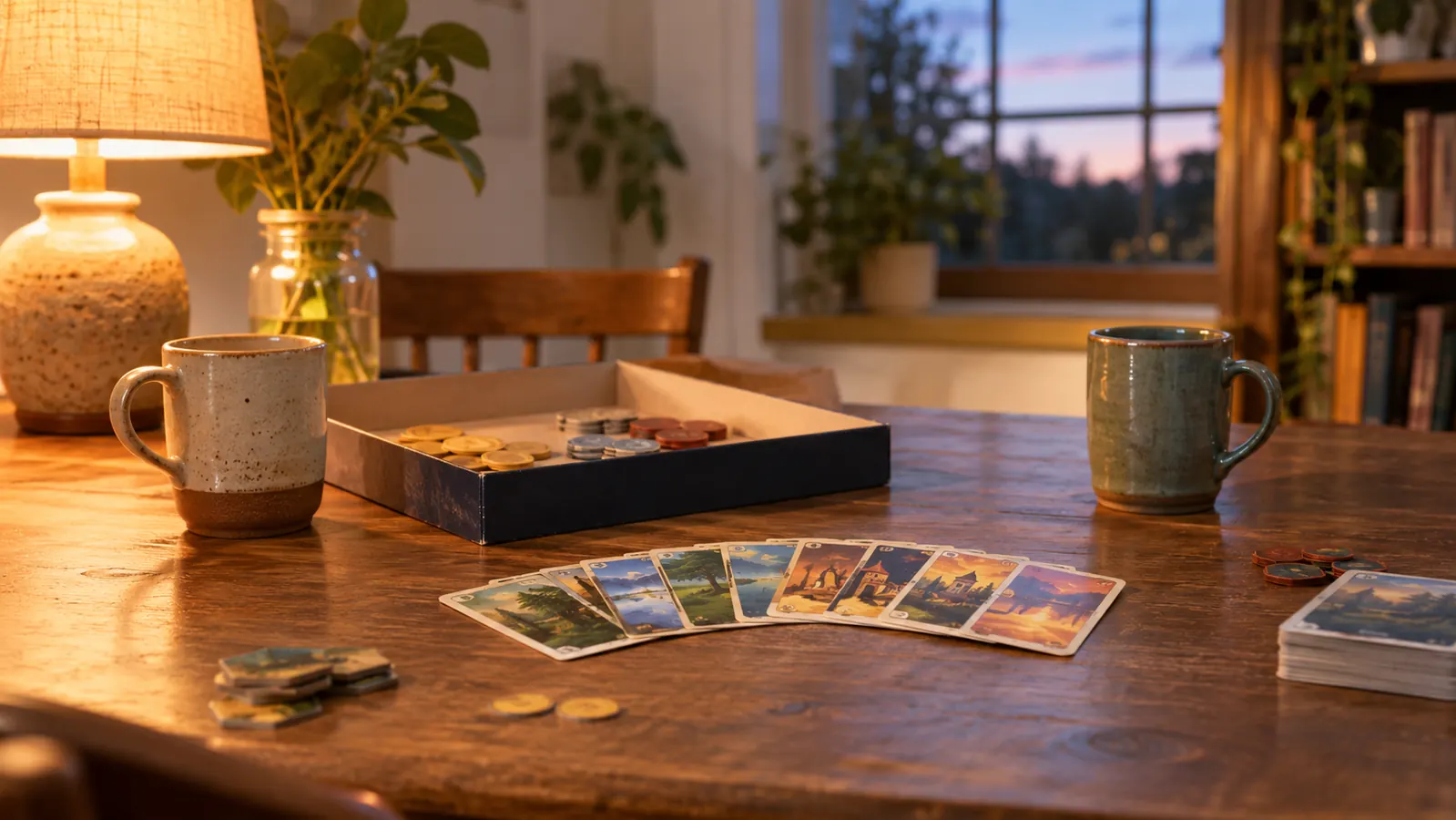
Friday night arrives and neither of us has the energy to go anywhere. Mark has been in and out of attics since seven in the morning, and I have spent the afternoon sorting donated paperbacks for the library sale. By eight o'clock, picking a movie has turned into twenty minutes of scrolling and one of us asleep in the recliner. That was the shape of our first year with the house to ourselves, and it wore thin fast. What broke the pattern was not a plan. It was a small box Mark set on the kitchen counter one Friday and said, sit down and try this with me.
The box was Asmodee's Jaipur, a two-player trading card game set in the markets of Rajasthan. It plays in about thirty minutes, it is built for exactly two people, and it takes up less table space than two dinner plates. Mark and I have played it at our kitchen table in Mesa more Friday nights than I can count, and the setup has become a small ritual we both look forward to. It takes under five minutes once you know it. What follows is the version of that setup I would hand to a friend, in the order I actually do it.
Two Players, Thirty Minutes, One Small Box
Jaipur is 55 goods cards, 38 goods tokens, 18 bonus tokens, and a single camel token. That is the whole thing. No board to unfold, no screen, no fourth person needed.
Amazon Check Today's Price on Amazon →The Five-Step Setup
Step 1: Clear the Table and Move the Phones Out of Reach
A card game for two does not need much room, but it needs clean room. I take everything off the kitchen table, including the mail, the laptop, and the bowl of fruit that has become furniture. Two chairs, across from each other or at a corner, whichever lets you both see the middle of the table. Then my phone goes in the drawer by the stove and Mark's goes on the charger in the hallway. That sounds fussy. It is the difference between a game and a background activity.
One thing I learned the hard way: use the box lid. There are a lot of small cardboard tokens in this game, and small cardboard tokens roll. I set the lid upside down in the middle of the table as a shallow tray and keep the token piles inside it. It takes ten seconds and it saves you from chasing a bonus token under the refrigerator at nine o'clock at night. When the weather is decent, we carry the whole thing out to the back patio, lid and all. The game travels well because there is nothing to it but cards and tokens.
Our table is forty-two inches across, which sounds like more than you need until you have laid out a market of cards in the middle and two hands along the edges. That leaves roughly a hand's width of margin on each side, and that margin is where mugs live. I learned to keep drinks on the counter behind us instead of on the table after a February night when Mark set his coffee down a little too close and I watched a stack of cards go damp at the corner. They dried flat and played fine, but we moved the drinks that same week and have not looked back. If your table is smaller than ours, put the token tray at the corner nearest the wall rather than dead center, and you will still have room for two hands of cards.
Step 2: Punch and Sort the Tokens Once, Then Leave Them Alone
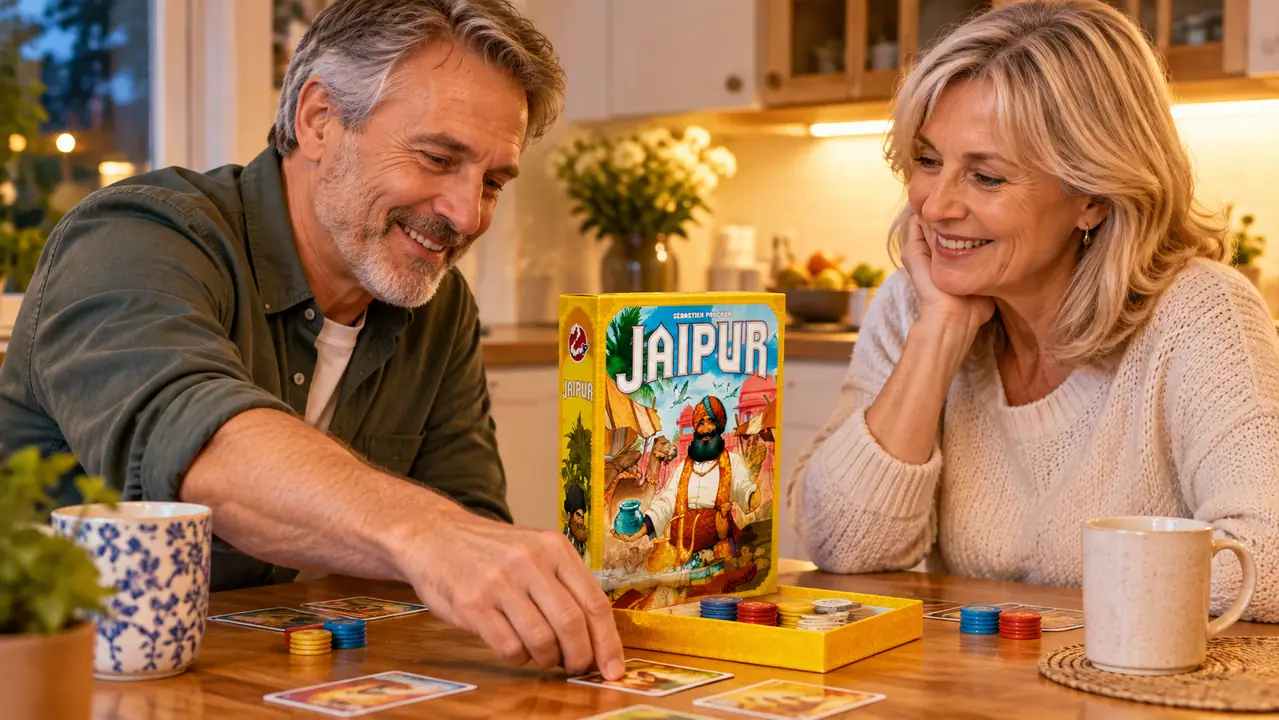
The first time you open the Asmodee box, the tokens are still in their cardboard sheets. Punch them out over the box so nothing lands on the floor. Then sort them once, properly. The goods tokens go in one small bowl or a zip bag, the bonus tokens in another, and the camel token sits where you can both see it. The Seals of Excellence stay in the box until somebody earns one.
Do this on a Sunday afternoon, not on a Friday when you are both tired. Sorting takes about ten minutes and you only ever do it once. After that, setup is open lid, put the cards in the middle, put the bowls down. I keep the whole box inside a larger zip bag on the shelf above the coat hooks, because that shelf is where things get shuffled around and I do not want to be hunting for loose tokens on a Friday.
While you are sorting, read the rules page out loud, once, together. Not separately, not silently. Out loud. I taught seventh grade for twenty-eight years and I will say this plainly: two people who read the same rules at different times end up arguing about them. Two people who read them at the same time end up playing.
The box itself is small, roughly the footprint of a hardback novel, and that matters more than it sounds. It sits on the shelf where a book would sit. It does not need a closet shelf or a dedicated cabinet, which is the reason a lot of two-player games never get played: they are too much trouble to get down. I have a friend in Gilbert who keeps hers in the basket by the front door, and she says it is the only game in her house that gets used, purely because nobody has to move anything to reach it.
Step 3: Deal a Practice Round You Both Agree Not to Count
This is the step that saves the night. Before you play for anything, deal a round and declare it a rehearsal. Nobody wins. Nobody gets a seal. You are just moving cards around to see how the pieces fit together. Say it out loud, both of you, so there is no quiet scorekeeping happening in somebody's head.
The first round is where all the small confusions show up. How many cards you hold. What happens when the market in the middle of the table runs thin. Whether you can sell two different goods in one turn, which you cannot. Working that out in a round that does not count is a completely different experience from working it out in a round that does.
Mark and I still play a warm-up hand most Fridays, and we have been at this a long while. It has nothing to do with skill. It is the same reason you take a few practice swings before you tee off. You get the feel of the cards in your hand, you stop thinking about the rules, and you start thinking about the person across from you.
I started this habit for a selfish reason. Our first attempt at a real game took forty minutes and ended with me explaining the market rules three separate times while Mark asked, reasonably, why he could not just take the card he wanted. It was not a fight, but it was not fun either. The next Friday we dealt a practice round first and did not keep score, and the whole thing took about twelve minutes and ended with both of us laughing at how obvious it all was. That twelve-minute rehearsal has probably bought us a hundred happier evenings since.

Step 4: Teach Three Moves, Not the Whole Rulebook
The rulebook is short, but you do not need all of it on night one. There are really only three things a player can do on a turn, and if you teach those three, the game teaches itself.
The first move is taking a card. You take one from the market in the middle of the table, or you take one blind off the top of the deck. The second move is the camel move. You can take the camels sitting in the market, and you can swap cards out of your hand for cards in the market. Camels are not goods, they are never sold, and whoever is holding the most of them when a round ends takes the camel token. The third move is selling. You lay down a group of cards that are all the same good, whether that is leather, spices, cloth, silver, gold, or precious gems, and you collect the matching tokens for it.
That is the entire game. Everything else is timing. The market is only so big, so a card you want may sit there while the other person decides whether to take it first. Your hand is only so big, so you cannot hoard forever. Sooner or later you have to sell, and what you sell tells the other person what you have been collecting. That is the part that gets interesting around the third round, when you stop playing the cards and start playing the person.
For the first several rounds, resist the urge to explain any of that. Just let them play. My husband is a man who reads instructions cover to cover before he will touch a new appliance, and even he learned more from one practice round than from the whole rulebook.
One habit that helps a teaching night go smoothly: let the newer player sell first when there is a decision to make, and do not narrate your own reasoning out loud while they are thinking. I used to do that. I thought I was being helpful. What I was actually doing was handing Mark my whole strategy in a low voice while he tried to decide about cloth. Now I keep my mouth shut and let him make the mistake, because a mistake you make yourself teaches you something a hint never will.
Step 5: Set a Stop Time and Write the Score Down
Decide before you deal how the night ends. We use a clock, not a round count. The winner of a round takes a Seal of Excellence, and the match goes to whoever collects two of them, which usually runs about an hour of actual play. Setting a hard stop at, say, ten o'clock means nobody has to be the person who says they are tired.
Then keep score somewhere you will see it. We have a small notebook on the shelf next to the box. Every Friday gets a line: the date, who took the seals, and one word about the night. It sounds sentimental. It also settles arguments, and after a year it is a record of fifty-two evenings you actually spent together instead of fifty-two evenings you spent on the couch.
Our notebook is a cheap spiral thing, four inches by six, and we are on the second one. I checked it before writing this. There are forty-one Fridays in the first book, and in eleven of them the single word I wrote was some version of tired, which tells you we did not always have a sparkling evening. But we had it together, at a table, with the phones in another room. The entries I like best are the boring ones. A date in October, the initials M.H., and the word rain.
What Else Helps
A few small things make the whole routine easier. A dedicated bowl for the goods tokens, so you are not sorting them out of the box lid every single week. A pen that lives with the notebook, not in the kitchen drawer where pens go to die. Good light over the table, because the tokens are small and the values are printed in fine print. And a standing night, the same night every week, so it stops being a decision and becomes a habit.
Have a second game on the shelf. Asmodee's Jaipur is the one we reach for most, but a steady diet of anything gets stale. Lost Cities is the natural next step if you want another two-player card game at a similar weight, and it fits the same thirty-minute slot. Keeping two boxes means the Friday plan survives the week when one of you wants something different.
And keep the stakes low. We do not play for dishes or chores, because a game where the loser has to clean the kitchen turns a pleasant hour into something with teeth. The seal is the reward. The conversation is the point. On the Fridays when we have talked more than we played, I consider that a good night.
Thirty minutes is the whole promise, and it holds. We finished a full round on a night when Mark had worked fourteen hours, and the tea was still warm.
One Small Box, One Night a Week
If you want a Friday that does not end in scrolling, this is the easiest version I know. Two players, thirty minutes, and a table you have to clear anyway.
Amazon Check Today's Price on Amazon →