

My husband Mark is a good sport about most things. He is not a good sport about learning new games. The last time I put a rulebook in front of him, he read three sentences, set it down, and said, "Just tell me what to do." That is a fair request. Rulebooks are written for reference, not for teaching, and reading one out loud to a tired HVAC manager on a Friday night is how game night dies.
So when I brought home the Azul board game, I did not hand him the book. I gave myself ten minutes and a script. He was playing in eight. He beat me twice. Then he asked when we could play again. I have now taught Azul to Mark, to two neighbors, and to my brother-in-law who claims he hates board games. The ten-minute version is the one that works, and this is exactly how I run it.
The game that got my skeptical husband to ask for a rematch
Azul plays in about 30 minutes with 2 to 4 players, ages 8 and up. Easy rules on the surface, real decisions underneath. It won the 2018 Spiel des Jahres for a reason.
Amazon Check Today's Price on Amazon →Why Ten Minutes Is the Right Amount of Time
Most couples teach games wrong, and I say that as a former middle-school teacher who taught roughly 3,000 twelve-year-olds how to write a topic sentence. The instinct is to explain everything before anyone touches a piece. That instinct is fatal. Adults do not want a lecture. They want to hold the pieces, make one move, and understand what they just did.
Ten minutes is enough to cover the rules of Azul because there are not many. You pick tiles. You place them on a row. The row scores when it fills. Everything else is detail you can teach in the middle of play. Twenty minutes turns into a lecture. Five minutes leaves them guessing. Ten is the sweet spot, and if you cheat and let them start playing at minute six, nobody has ever complained.
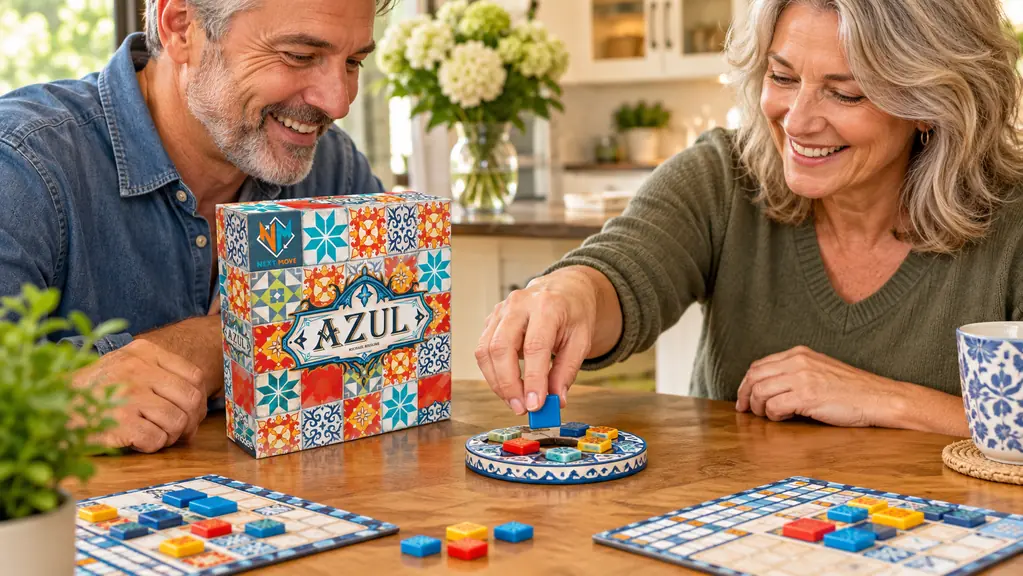
Before You Start: The Two-Minute Setup
Set the table up before your spouse sits down. This is the single highest-leverage thing you can do. A game that looks ready pulls people in. A game in a box with a rulebook on top looks like homework.
Azul comes with 100 resin tiles, 4 player boards, 9 factory displays, 4 scoring markers, and 1 starting player marker. For two players, you only use some of that. Put out two player boards facing each other, five factory displays in the middle, and leave the rest of the box on the floor. The other boards and factory pieces become clutter and clutter reads as complexity. A man sitting down to two boards and five little cardboard circles thinks, "I can do this." A man sitting down to a full spread of components thinks, "How long is this going to take."
Then shuffle the tiles facedown and push them to the center of the table. Fill the factory displays. Do this with your back turned if you must, because the moment the tiles are out and glinting, the questions start on their own.
Step 1: Name the Goal in One Sentence
Before a single rule, tell them what winning looks like. One sentence, no numbers. Mine is: "You are building a wall of tiles in front of you, and the points come from how well you arrange it." That is it. That is the whole game in one line, and it gives an adult brain something to hang every later rule on.
Do not explain scoring yet. Scoring is the part that makes eyes glaze over because it arrives as a formula: connected tiles horizontally score one point each, connected tiles vertically score one point each, plus bonuses for completed rows and columns. That is six facts delivered in one breath, and none of them mean anything before a person has touched a tile. Save it. Defense against confusion is the goal in minute one, not accuracy.
If your spouse asks "how do you win" and you say "most points," you have satisfied them. They will not press for the algorithm. Let them believe it is simple for another ninety seconds.
Step 2: Teach the Draft in One Move, With Your Own Hands
This is the heart of the lesson, so do it physically rather than verbally. Take a factory display with four tiles on it. Say: "On my turn, I take all the tiles of one color from one factory, and everything left over slides to the middle." Then do it. Pick up your tiles. Move the leftovers to the center. Place your tiles on a row of your player board.
Now here is the part that makes Azul click for a new player, and you should say it out loud because it is the actual strategy hiding in the rules: "Anything I leave behind, Mark gets to take. So if I take three of these, I am handing you the other one." He will immediately look at the leftovers. The light comes on. Draft and deny is the whole engine of Azul, and it lands in about fifteen seconds when you frame it as giving something away instead of as a rule about excess tiles.
Then hand him the tiles and let him take his first turn. Do not correct him if he picks something suboptimal. Do not narrate. Let the first turn be his. A first turn that belongs to the learner is worth ten explanations.
Step 3: Explain the Row Rule as a Shopping Trip
The one genuinely fiddly rule in Azul is what you are allowed to do with the tiles you take. Each row on your player board holds a specific number of tiles, one holds one, the next holds two, up to five. You must place tiles only in a row that has space, and only if the row is empty or already holds that same pattern.
I stopped trying to say that cleanly. Instead I say: "Each shelf takes a certain number of tiles and only one pattern. If a shelf already has blue on it, you can add blue. You cannot start a second pattern on the same shelf." Then I point at the shelves. Shelves is a word everyone already understands from their own kitchen, and the row on the board genuinely looks like one.
The penalty rule, that leftover tiles cost you points, I mention once and lightly: "If you take more than a shelf can hold, the extras cost you a point each." Mark nodded, forgot it, took a bad batch in round three, and never forgot it again. Learning by losing two points is faster than learning by hearing a warning.
Step 4: Play Round One Wide Open and Score Together
For the first full round, play with your board angled toward him and talk through your thinking out loud. Not every thought. One per turn. "I am taking these two so you cannot finish your row." "I am avoiding that pile because I do not want three leftovers." He is learning strategy through your voice, which is a much easier channel than a rulebook.
Then score the first scoring round together, slowly. This is where the game reveals itself, because a person who has just filled a full row on their board and watches it score will understand the vertical bonus without you finishing the sentence. Azul gives points for connected tiles running both directions, plus bonuses for completed rows and columns, and every one of those lands better as a discovery than as a lecture.
Expect one round of confusion. That is normal and it is not a sign that your spouse is not a game person. It is a sign that scoring in Azul is genuinely more interesting than the rules suggest, which is the reason the game has stayed on our table for months.
Step 5: Hand Over the Rulebook and Stop Talking
At the end of round one, put the rulebook on the table beside him and say, "It is all in there if you want it. I am done explaining." Then be done. This step matters more than any explanation you gave, because it converts the lesson from instruction into ownership. He is not being taught anymore. He is playing a game he happens to know.
Nine times out of ten the book stays closed. Once in a while he will flip to the scoring page during a lull, and that is fine too, because now he is checking a reference instead of receiving a lecture. Either way, the ten minutes is over and the next thirty belong to the game.
One last piece of teacher advice: do not win. Not the first night. Not obviously throwing it, but do not grind him into the table with a beautifully built wall while he is still counting shelves. Azul is a head-to-head game at two players and it is genuinely strategic, which means a first night loss that feels like a lesson kills the whole project. Play a little loose. Let him win one. You will get your revenge for years.
I take three of these, I am handing you the other one. The whole game lands in that one sentence.

What Else Helps
The single biggest thing that helped us was playing at the kitchen table with the TV off. That sounds too obvious to write down, but our first attempt happened during a football game and it was a disaster. Azul asks you to watch what the other person is collecting. Half attention is not enough, and neither of you will admit that is why the game felt pointless.
Second, keep the first session to one game. Azul runs about 30 to 45 minutes. That is one clean arc, and it ends while everyone still likes each other. We tried a second game on night one once and it was fine, but the second game is where fatigue sets in and the small rule disputes start. Save the rematch for tomorrow. The wanting is useful.
Third, if you have a third or fourth player, teach everyone at once with the same five steps and let the experienced players sit next to the new ones. Azul scales to 3 or 4 players without adding rules, which is not true of most games, and teaching a group takes the pressure off your marriage. Nobody feels watched.
And if your spouse genuinely does not take to it, that is real information, not a failure on your part. Not everyone wants to spend forty minutes managing a tile economy. If you want the fuller picture of what this game is like night after night, I wrote about that separately in my long-term Azul review, and the comparison between Azul and Splendor is the one to read if your spouse is the type who likes numbers and engines. For the version of game night that does not involve a board at all, I keep a list of ten reasons Azul works for couples who do not play board games, which is honestly the article most people need.
Ten minutes to teach. About 30 to play. Thirty-one years and counting at this table.
Azul: 2 to 4 players, ages 8 and up, 100 resin tiles, 9 factory displays, 30 to 45 minutes per game. The game my husband asked to play again.
Amazon See Today's Price on Amazon →