
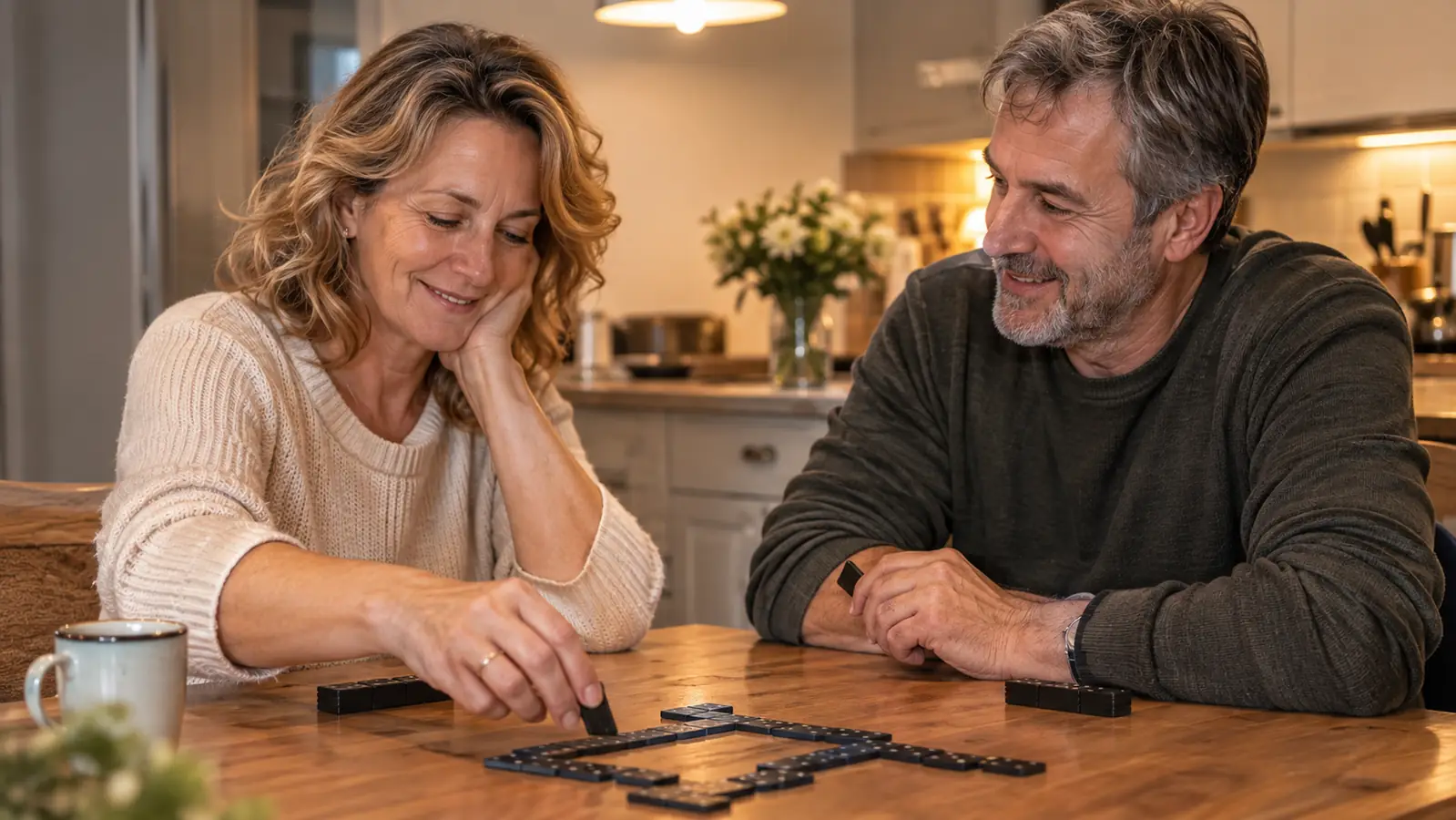
The first Friday night we played Azul, my husband Mark finished the game and said, "That was actually good." Thirty-one years of marriage and I can count on one hand the number of times he has said that about something I brought home from a store.
We are 56 and 58, our kids are grown and out of the house, and quiet Friday nights turned out to be harder to fill than I expected. So I started bringing home games. Most of them got one play and then sat in the closet behind the vacuum. Azul is the one that came back to the table the following week, and then the week after that. Four months later it is still in the living room, and the box is starting to show wear on one corner.
The Quick Verdict
Fast to learn, genuinely tense with two players, and the rare game that gets a reluctant husband to ask for a rematch. The tiles are small and the table can get crowded, but this is the one that stayed.
Amazon Check Today's Price →See what Azul costs today before your next Friday night
Two players, thirty minutes, no rulebook rescue needed after the first game. That is the whole pitch.
Amazon Check Today's Price on Amazon →How I've Used It
We play at the kitchen table, usually after dinner, usually with the radio on low. Mark is an HVAC service manager and comes home with a head full of work, so I look for games that do not require him to read a paragraph of rules before he can take a turn.
Our first game of Azul took about forty-five minutes, and twenty of that was me reading the rules out loud with my reading glasses pushed up on my head. The second game took thirty. By the third Friday we were not opening the rulebook at all.
Before Azul, I tried three other things. A movie trivia game that Mark won on the first night and then refused to play again, because in his words there was nowhere to go once you had won it. A card game with a rulebook that ran nineteen pages, which I read twice and still got wrong, and which we abandoned halfway through with the cards still spread out. And a conversation deck, which I still think is a good idea, but which Mark treats like homework. None of those made it past week two. Azul made it past week two because the rules fit on a single page and the decisions underneath them do not run out.
We started in June, which in Mesa means the patio is off limits until October. So the first three months were kitchen table only, air conditioning running, ceiling fan going, a glass of iced tea turning warm beside my board. When the heat finally broke in mid-October we carried it outside twice. The second time the wind took two tiles off the table and we spent five minutes on our hands and knees in the dark feeling around the patio stones. We are kitchen table people now.
Since then we have played it somewhere between thirty and forty times. Two players almost every time, with a handful of four-player games when our grown kids visited and when Mark's brother and sister-in-law came through town. I have now taught it to six different adults, ages 41 to 69, and every one of them was taking a turn within five minutes.
What Comes in the Box, and Why the Pieces Matter
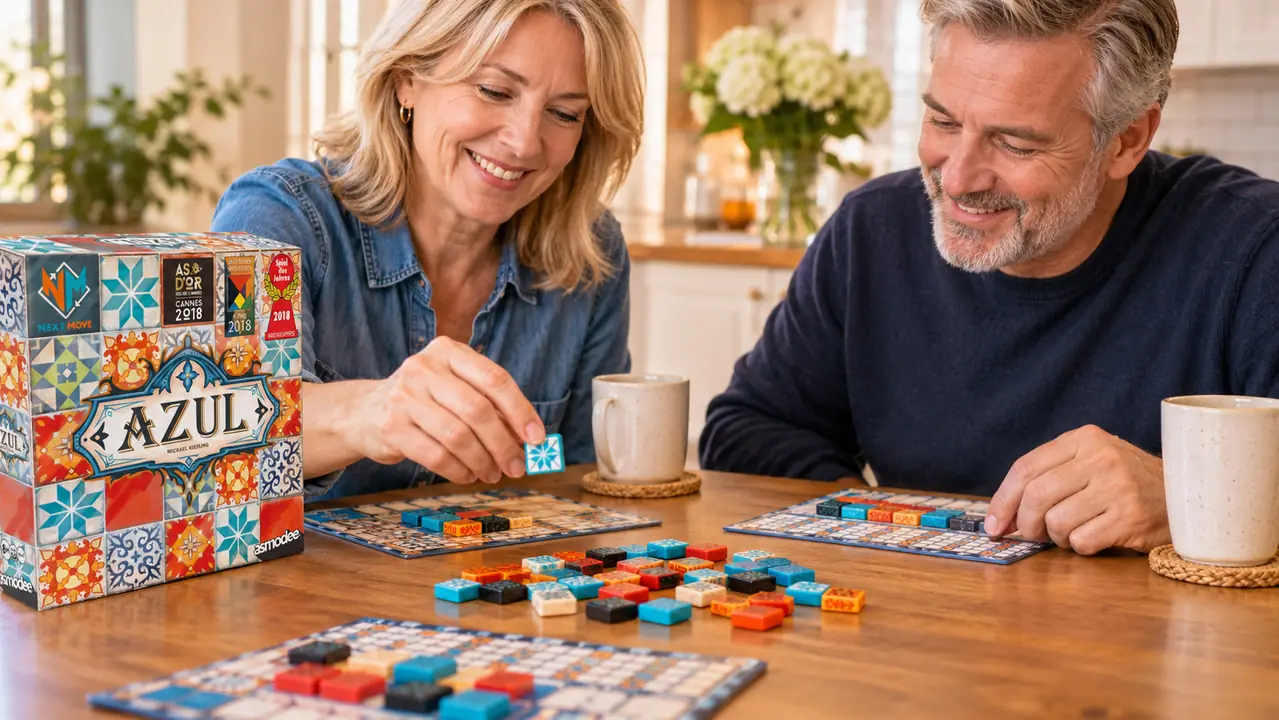
Azul comes with 100 resin tiles, four player boards, nine factory displays, four scoring markers, and a starting player marker. That is the whole inventory. No cards to shuffle, no dice to roll, no timer, no app, no token bag that splits its seam in month two.
The box weighs just over two and a half pounds, light enough that I keep it on the shelf beside the cookbooks instead of buried in the closet, which matters more than it sounds. A game you have to dig out is a game you skip. There is a molded insert inside that holds the nine factory displays in a stack with the tiles in their own compartment, and after four months of use I still put everything back where it belongs. I am not naturally that kind of person. The insert makes it easy to be.
The first night I counted the tiles into little piles on the table to be sure all 100 were there. That took ten minutes I will never get back, and they were all there, and I have not counted them since.
The tiles are the reason the game works. They are chunky and cool in the hand and they make a lovely click when you set one down. I did not expect to care about that. I care about it now. It is the difference between a game that feels like an obligation and one you want to touch.
The nine factory displays are small round discs, and each round you load four tiles onto each of them. You take all the tiles of one color from a single display, and the leftovers slide into the center of the table. That mechanic, the leftovers going to the middle, is where the whole game lives. You are not just collecting. You are deciding what you leave behind for the other person.
The maker is Asmodee, and Azul won the 2018 Spiel des Jahres, which is the German game of the year award. I mention it because it explains something: this is a game with simple rules and a real brain underneath, and the award is why your more serious gaming friends have probably already heard of it.
How It Actually Plays for Two People
The rules are simple enough to state in a sentence. Each round you draft tiles from the shared displays and place them into pattern rows on your board. Complete a row and you push one tile onto your wall, where it scores. Take more tiles than your row can hold and the extras fall to the floor, which costs you points.
That is it. That is the game. And yet after four months I am still noticing new ways to be mean about it.
The rows are not all the same size, and that is the part that took me longest to feel in my hands. The top row holds one tile. The bottom row holds five. If I grab five tiles for a row that already has two in it, three of them go to the floor line and cost me points for the privilege. I did that for the first six weeks without really understanding I was doing it, and then one Friday I lost by nineteen and finally sat with the rulebook for ten minutes and worked out why. I have not made that mistake much since.
Here is what surprised me. With two players, Azul is not a gentle game. It looks gentle. The tiles look like a craft project. But because the leftover tiles go to the middle and whoever takes from the middle goes first next round, you can absolutely strand your opponent. There is a version of this game where I take three tiles I do not strictly need, purely so Mark has to take the leftover pile and dump four tiles on the floor.
The first time I did that, he looked up at me over his glasses and said, "Oh, so that's how it is." The next week he did it back to me twice. That is the shape of a good two-player game, and Azul has it.
The closest game we have had was in September. Mark was ahead by eleven going into the last round and I had two rows set up to finish. I took four tiles off one display to complete a row of four, which let me place a single tile on my wall, and that tile happened to land directly beside two I already had. He finished a row of his own in the same round. We counted the track twice because neither of us believed the number, and I won by three. He has brought it up roughly once a week since, which is the closest thing to a compliment that man gives out.
With four players it loosens up and gets friendlier, which is fine and probably better for a group that includes someone's brother-in-law who is not really a game person. Two is the sharpest version, and two is what we are.
The first time I stranded him on purpose, he looked up over his glasses and said, "Oh, so that's how it is." The next week he did it back to me twice.
What Fell Flat After Four Months
I have to be honest about three things.
The first is the table space. Our kitchen table is forty-two inches across, and with two player boards and nine factory displays it is comfortable, with room for a plate of something. With four player boards it is not. The night Mark's brother and sister-in-law visited, we moved the central pile onto a cutting board on the counter and everyone spent the evening reaching backward over their shoulder. We played once on the patio with a small round table too, and spent the whole game nudging things back from the edge.
The second is the small pieces and small hands. The manufacturer suggests ages eight and up, and I taught a nine-year-old neighbor without much trouble, but the tiles are genuinely small and the rows on the player board are narrow. If someone in your house has trouble with fine motor control or picks things up with more difficulty than they used to, this is worth thinking about before you buy. My mother, who is 81, can play, but she prefers to have me move her tiles for her.
The third is the score. There is a scoring marker and there is a track around the edge of your board, and it works exactly as it should, but scoring happens at the end of every round and the arithmetic is not always instant. Some nights I get it in two seconds and some nights I count the same row of tiles three times, once out loud, while Mark waits with his chin in his hand. It does not ruin anything. It does slow the last five minutes of each round, and on a night when one of us is tired it can feel like a chore rather than a game.
The box itself is also wearing. Not failing, just wearing. The corner where I lift the lid has gone soft, and the insert holds everything well enough that I have not bothered to put anything in a bag. If you move house with this game twice, buy a rubber band.
What did not fall flat: the tile placement strategy, or the draft and deny part where you take tiles to keep them out of the other person's hands. It is still interesting after four months. I cannot say that about much.
What I Liked
- Playable correctly within ten minutes of opening the box
- Two-player duels stay tense for months
- Beautiful tiles that feel good to handle
- Zero cards, dice or timer, so nothing to lose or wear out
- Scales from two to four without a different rule set
- Great for a couple who do not consider themselves game people
Where It Falls Short
- Table hogs real estate with four players
- Tiles are small, which is harder for older or arthritic hands
- Scoring every round means a little arithmetic at a steady pace
- The gentle look hides a sharp, occasionally ruthless game
Who This Is For
If you and your husband or wife want an evening activity that is not a screen, and one of you is not a board game person, Azul is the safest recommendation I can make. It is not heavy, it is not complicated, and it does not ask anyone to role-play a wizard or remember nine enemies' names.
It also suits couples where one partner is more competitive than the other. Mark does not care about winning in any way that shows, and I care more than I would like to admit, and the game absorbed both of us fine. He gets to play casually, I get to plot, and neither of us has to apologize.
I would also recommend it for a couple who wants a game that kicks off conversation rather than replacing it. Azul is quiet enough to talk over. That mattered to us. Some of our best nights with it were half about the tiles and half about Mark's brother's new house or whether we were ever going to redo the bathroom.
Who Should Skip It
If you already own Splendor, you should think about whether you need both. They scratch a similar itch, drafting and building toward a score, and while I think Azul is the warmer game to sit with, you are not missing a category. There is a longer comparison on the site if you want the side by side.
If you want a game that fills three hours, this is not it. Thirty to forty-five minutes is right, and when we have tried to stretch it with extra rounds the fun thins out. Same goes for anyone looking for a story game, a conversation deck, or something to play over a bottle of wine with lots of talk. Azul rewards attention. It is not a background activity.
And if you need large print, large pieces or a game that works by touch, look elsewhere. Azul is beautiful and its beauty is its weakness in that regard.
A last note on the long term, since that is what you asked for. Four months in, I still want to play it, which is the only honest test I know. It has not replaced Friday nights. It has made them easier to look forward to.
Four months in and it is still on my table. Check today's price on Azul.
Thirty to forty-five minutes, two to four players, ages 8 and up. Enough play in the box to carry you through a season of Friday nights.
Amazon Check Today's Price on Amazon →