
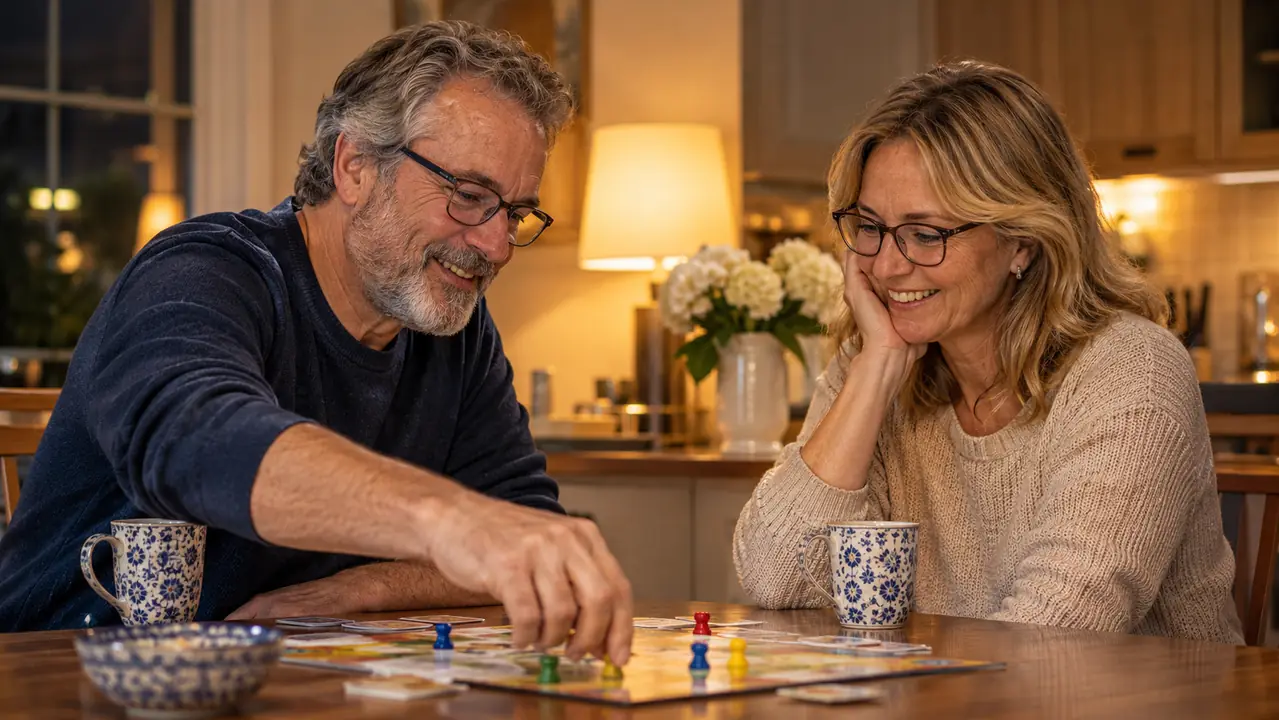
If you are standing in the game aisle trying to pick one box for Friday night, here is the short answer. Azul is the better two-player game for couples who want something to talk about afterward. Splendor is the better choice for couples who want a game they can teach in three minutes and play with half their attention on the oven. We own both. They sit on the same shelf in our kitchen in Mesa, and when it is just me and Mark at the table, Azul is the one that comes down more often.
That still surprises me a little. Splendor is the game that started all of this for us. Mark is an HVAC service manager, which means by Friday at six his head is full of pressures and part numbers, and Splendor was the first game simple enough to slide into a tired brain. For a long time it was the default. Then somewhere around our twentieth play, Azul started producing the turns we were still quoting at breakfast the next morning. This is not a knock on Splendor. It is a report from one kitchen table in Arizona.
| Azul | Splendor | |
|---|---|---|
| Players | 2 to 4 | 2 to 4 |
| Two-player feel | Head-to-head duel with real denial | Two engines racing side by side |
| Time to teach | About five minutes | About three minutes |
| Turn length | Short, but you will study the displays | Often under fifteen seconds |
| Table space | Nine factory displays plus four player boards | Two card rows and a token pile |
| Age range | 8 and up | 10 and up |
| Pieces in hand | 100 resin tiles with real weight to them | Gem tokens you slide around |
| Replayability | Different every time the tiles hit the displays | Different every time the card row turns over |
| Theme | Building a mosaic wall you can actually see | Trading gems to impress nobles |
Where Azul Wins
The first thing Azul has that Splendor does not is a reason to look at your spouse. On your turn you take every tile of one type from a single factory display, and whatever you leave behind slides into the middle of the table where anybody can scoop it up. So you are not just deciding what you want. You are deciding what Mark can still get if you take it first. Denying him a set he has been building for three rounds feels personal in a way that buying a card never quite manages. He calls Azul the mean game. He says it fondly. I think.
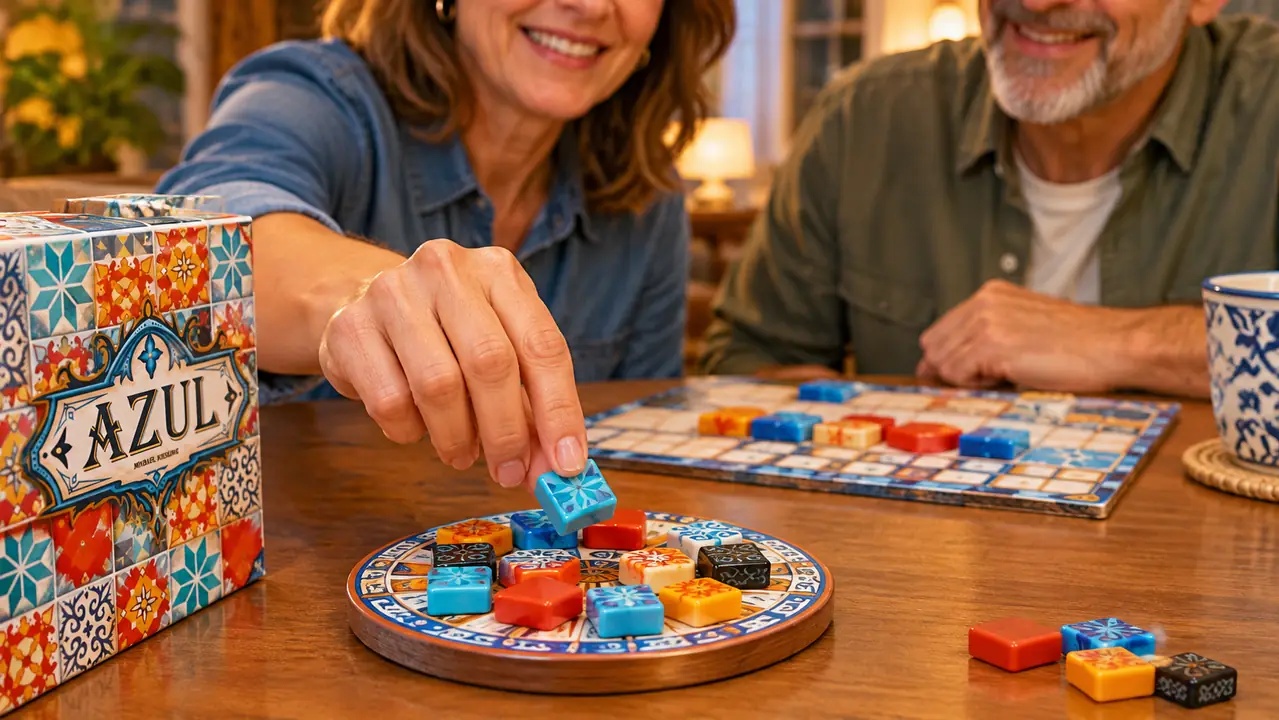
Second, the pieces. The box has 100 resin tiles, four player boards, and nine factory displays, and those tiles have real weight in the hand. There is a small click when you set one down that the gem tokens in Splendor do not make. I know how that sounds. But the physical feel of a game matters more at fifty-six than it did at thirty, because half the pleasure now is the ritual of spreading everything out and pushing it around for an hour. Azul gives you a table worth spreading out.
We measured it once, the way you do when you are deciding whether a game can live outside. Azul laid out for two players needs close to thirty inches of width once the nine displays are arranged and both boards are sitting in front of you. Our patio table is thirty-six inches and it fits, but there is nothing left over. The first warm night we tried it out there, we set the tile bag on a chair because there was no room on the table, and Mark knocked it onto the concrete reaching for his iced tea. We play Azul indoors now, at the kitchen table, under the light, and it is a better room for it anyway.
Third, it keeps both players awake. You score at the end of every round, so nobody sits there for forty minutes waiting to discover they lost. Mark and I have both played games where we knew by round two how the whole thing would end, and Azul at least lets the loser go down swinging. It is rated for 8 and up, so a younger player can join without anyone dumbing the game down, and that 2018 Spiel des Jahres on the box was not a fluke.
Where Splendor Wins
Splendor wins the teaching contest and it is not close. You take gem tokens, you spend them on a development card, the card gives you a permanent discount on future cards, and after a while the little engine runs itself. I have taught it to people who announced they do not like board games, and they were playing correctly inside five minutes. Three tiers of cards and a row of nobles to chase, and that is the whole thing. Azul takes about the same time to explain, honestly, but Splendor's rules leave less room for the moment where somebody says wait, what happens to the leftovers.
I taught both games to a couple we had over in the spring, and the gap showed up fast. Splendor took one pass through the rules and they were off, and by the second game they were arguing about who got to the sapphires first. Azul took one pass and then a full practice round where nothing counted, because the leftovers rule does not click until you have watched it happen twice. That practice round is not a defect. It is just an extra ten minutes, and if the people at your table are already skeptical, ten minutes is a long time to hold somebody in their chair.
The second thing Splendor does better is respect your evening. Turns are short. You take tokens or you buy a card, and most turns are over in fifteen seconds, so there is very little sitting and watching. On a night when one of us is still winding down from work, that matters. Splendor also takes less table. Two card rows, a token pile, and your own stack of purchased cards. Azul needs the nine factory displays plus the boards, and on our patio table that leaves no room for the glasses.
Splendor is also more forgiving of interruption. If the phone rings or somebody needs to step away, it waits patiently. Azul is harder to pause mid-round because the factory displays change on every single turn, so a five minute break means five minutes of re-reading the table when you sit back down. That is not a flaw exactly. It is a cost, and it is one you pay on a night when you are tired.
How They Play With Four
Both games are listed for 2 to 4 players, and they handle a crowd differently. Azul with four is a busier, noisier version of the same game. The displays empty faster, the middle of the table fills with leftovers nobody wanted, and you have three people to consider instead of one. It is still good. It is just less personal, and the personal part is the whole reason to own it.
Splendor with four is closer to where the game wants to live. More players means more competition for the same development cards, and the nobles turn into a genuine race instead of a private puzzle. The tradeoff is length. A four-player Splendor game can run long enough that the quiet charm wears thin, and one player who gets an early engine going can run away with it while the rest of the table watches.
For two players, which is the question here, Azul takes it, but by less than the table above makes it look. The margin is the deny move and the pieces. Everything else is close enough that a couple could reasonably land on the other answer.

What a Friday Night Usually Looks Like
Here is the honest version of how these two get chosen in our house. If we start at seven and one of us has an early morning, Splendor comes out. It fits in thirty minutes, nobody has to concentrate very hard, and we can talk over it. If we start at eight with nowhere to be, Azul comes out, because Azul is the one that produces a story.
The last time we played, Mark spent four turns quietly collecting the same tile type and I did not notice until it was too late. I took two of them out from under him mostly by accident, which he did not believe, and he spent the rest of the game taking things I needed out of pure spite. It came down to four points. He won. He has mentioned it twice since, both times unprompted.
For the record, that was the second Friday in March, and the game took closer to forty minutes than thirty because I kept getting up to check on the oven. Mark keeps score on the back of an old envelope, since the scoring pad that came with the box fell behind the microwave in 2019 and we never replaced it. There is something about a game that produces a number at the end. You can point at it. When he says he won by four points, he can prove it, and when I say I let him win, we both know that is not true.
That is the thing Splendor cannot do. When Splendor ends, you talk about how the engine came together. When Azul ends, you talk about the round where somebody got robbed. For a date night at the kitchen table, the second conversation is the one worth having.
The Game We Were Still Arguing About at Breakfast
100 resin tiles, nine factory displays, four player boards, and a two-player duel where taking the wrong tile costs you your whole evening. Rated 8 and up, 30 to 45 minutes.
Amazon Check Today's Price on Amazon →What Neither Game Will Do for You
Neither of these is a conversation deck, and I want to be straight about that because they get sold right next to each other now. Azul and Splendor will not teach you anything about your husband you did not already know. What they do is put you across a table from each other for thirty or forty minutes with something to react to, which is more than the television manages.
There is also a real ceiling on how often either one gets played. We go in streaks. Three Fridays in a row, then a month where the box stays on the shelf because life is busy. That is normal, and a game you play twelve nights a year is still a good buy. A game you feel guilty about is not. Buy one of these, not both, unless your house already rotates through five games a month.
Who Should Buy Which
Buy Azul if you are mostly playing as a couple and you want the game to hand you something to react to. Buy it if you like the idea of denying your spouse a tile and hearing about it for the rest of the evening. Buy it if somebody in the house is 8 or older and might join. Buy it if the physical feel of a game matters, which at our age it usually does.
Buy Splendor if you want something you can teach skeptical adults in five minutes, if your Friday nights start late and end early, if the table is small, or if you need a game that survives being interrupted. It is also the easier one to carry, since a card row and a token pile travel better than nine factory displays and four boards.
One more thing about buying. The store will happily sell you both at once, and the write-ups on each box will make each one sound essential. We bought Splendor first, in 2019, and Azul about a year later, and if I could redo it I would still buy them in that order, because Splendor is the gentler on-ramp for a couple who has never played anything together. What I would change is the gap between them. A year is too long to wait for the second one. If Splendor has already stopped coming off the shelf, the fix is not a new edition of Splendor. It is a different game.
If you already own Splendor and it has gone a little quiet in your house, Azul is the natural next box because it uses a different muscle. If you own neither and you are buying one box as a gift for a couple you like, Azul is the one I would hand over. It is the one people bring up afterward.
One Box, Two Players, Thirty Minutes
If your Friday nights have gotten quiet, this is the simplest way back to a table with somebody sitting across from you. See the current rating and the review count before you decide.
Amazon Check Today's Price on Amazon →