
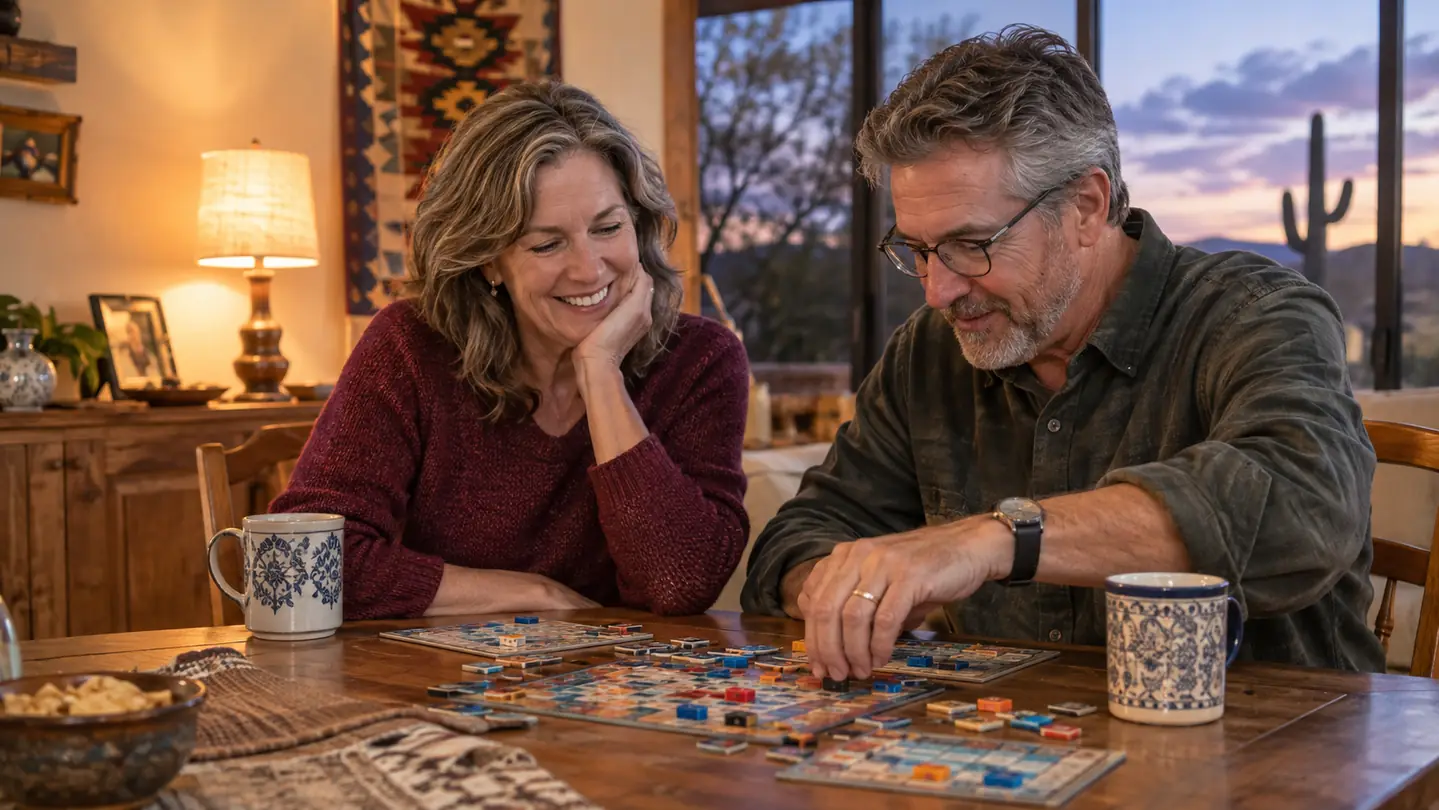
The rut snuck up on us. Mark and I have been married thirty-one years, and somewhere between raising two kids and getting them both out the door, our Friday nights turned into two people in the same room looking at two different screens. Dinner, dishes, phones on the table, a show we had already seen. By nine o'clock we had said maybe forty words to each other that were not about the HVAC schedule or whether the trash went out.
We tried to fix it the obvious ways. I bought one of those conversation card decks, the kind with a question printed on every card, and we made it through about eleven of them before it started to feel like a staff meeting. We tried a jigsaw puzzle, which was pleasant but quiet in a way that never got us talking. We tried renting a movie, which is not really doing something together. It is two people doing nothing in the same room.
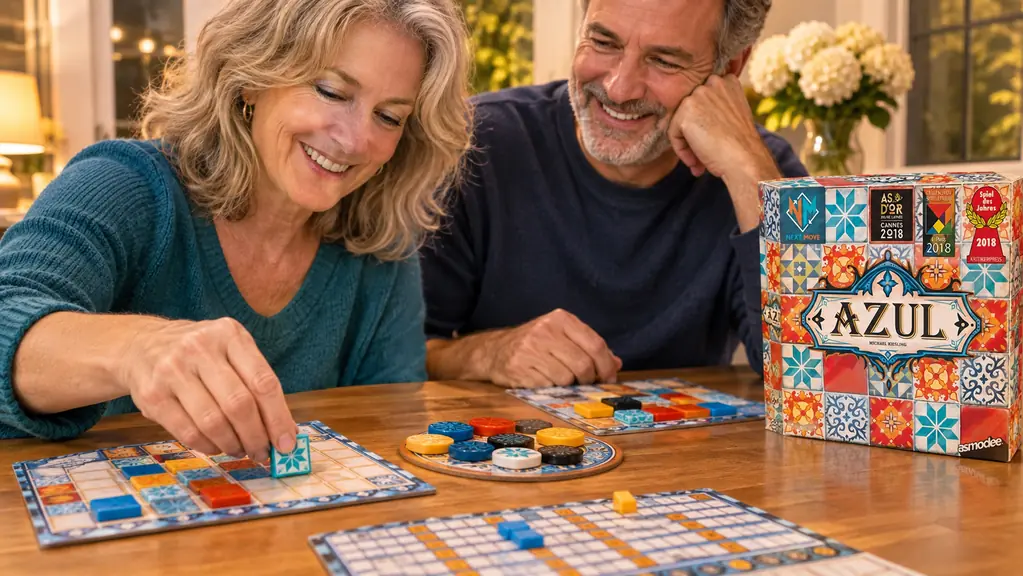
Then our neighbor, the sort of person who always knows what is good before the rest of us do, left a box on our counter. Azul. I had seen it in the game aisle and assumed it was one of those things with a rulebook the size of a phone book. I set it aside for three weeks.
One Friday I got home before Mark and opened the box out of boredom. It is not complicated. The whole game is 100 resin tiles, four player boards, nine factory displays, four scoring markers and one starting player marker. That is the entire list. Mark read the rules out loud while I made coffee, and by the time the coffee was gone we were playing.
The first round took us thirty-five minutes, right inside the thirty to forty-five minute window on the box, and I lost by a margin I would rather not publish. But here is what actually mattered. For thirty-five minutes neither of us touched a phone. Not once. And it was not the grim, deliberate kind of not touching. I genuinely forgot where I had set mine down.
It happened again the next Friday. And the one after that.
For thirty-five minutes neither of us touched a phone. Not once. It was not the grim, deliberate kind either. I genuinely forgot where I had set mine down.
One Box, Nine Factory Displays, and a Friday Night That Stopped Being Silent
If your evenings have turned into two screens and forty words, start here. Azul plays in about half an hour and needs nothing but the table you already have.
Amazon Check Today's Price on Amazon →What makes it work on a marriage, I think, is that you are not playing against the board. You are playing against the person across from you, and you are both drawing from the same pool. On a turn you take tiles from one of the nine factory displays, and every tile you take is a tile Mark cannot have. That means you have to look at him. You have to think about what he is building and decide whether to take the tile he needs or let him have it and take something better for yourself.
That sounds cutthroat. It is not, mostly. The drafting part, where you pick and pass, keeps the whole thing conversational. Half our games are spent narrating bad decisions out loud. Mark has a habit of taking the tile I wanted and then saying, cheerfully, that he did not realize I wanted it. He realized.
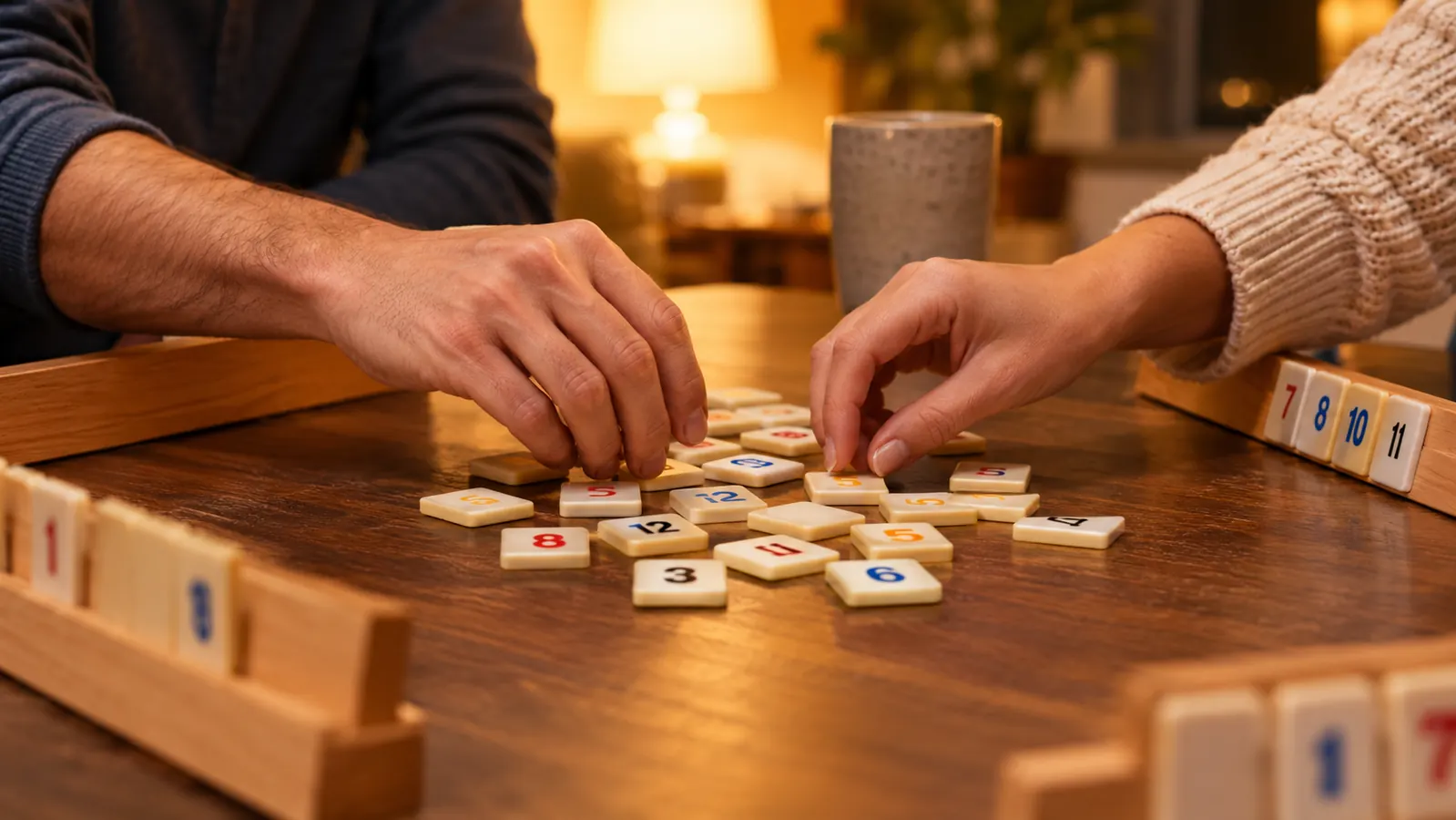
Two players is where we live, and the box says two to four. We have played it with the neighbors at four, which is a louder and more chaotic game, and with one of our kids over the holidays, which turned into a tournament. But the two-player version is the one I would defend. It is fast, it is quiet enough to talk over, and it is pointed enough to be interesting.
Now the honest part. Azul is not going to fix a bad week. It will not teach you how to talk about money. What it does is give two tired people a shared thing to look at that is not a television, and about half an hour of conversation that does not begin with, how was work.
There are things I do not love. If you are someone who has to win, the scoring at the end of each round can sting, and Mark has had to listen to me recount a lost round tile by tile. The first two games are slower than the rest because you are still learning the tile patterns. And there is a real risk of playing one more round at ten o'clock on a night when you have work in the morning. We have done that four times that I will admit to.
We still have the phones. They are still on the table, face down. But they are face down now instead of in our hands, and the difference between those two things is bigger than it sounds. Azul earned its spot on the shelf next to the coffee maker, which is the highest honor a game gets in this house.
What I'd Tell You If We Were Sitting at My Kitchen Table
I would tell you not to buy it as a gift for someone else and then never open it. I would tell you to play the first game on a night when nobody is tired or hungry, because the learning curve is small but it is not zero, and a first game played badly can talk you out of a good thing. I would tell you to keep score across the month, not across one evening, because Mark wins single rounds and I win the long run and we both find that funny.
And I would tell you the small thing that surprised me most. It is not the game itself. It is that thirty-one years in, there is still a version of my husband I only see when he is trying to decide whether to take a tile. Focused, a little smug, entirely present. I did not know I had been missing that until it was across the table from me again.
The Game That Got Us Off Our Phones on a Friday Night
Azul, 2 to 4 players, 30 to 45 minutes, ages 8 and up. Start with one round and see what your table sounds like.
Amazon Check Today's Price on Amazon →