

The first thing I noticed about Azul was not the game. It was that Mark, my husband of thirty-one years, was arguing with me. Not the tired Friday argument about whose turn it is to load the dishwasher. A real argument, with a position and a counterposition, about which of us should get a particular tile off a factory display. He took it. I let him, mostly because I was too surprised to fight back. That was our fourth Friday with the box open on the kitchen table in Mesa, and I remember thinking that if a board game can get that man to make a case for himself out loud, it is worth writing about honestly.
I am not a game reviewer by trade. I taught eighth grade English for twenty-eight years, and I have spent the first stretch of an empty nest trying to find things Mark and I will actually do together on a Friday night instead of watching whichever one of us reaches the remote first. Some of what we tried was a waste of an evening. Azul is not. But it is also not the smooth, frictionless little thing the box suggests, and most of what I want to tell you is the part that never makes it into the product description.
The Quick Verdict
A genuinely clever tile game that pulled conversation out of a quiet man, with a scoring round that can still sting after thirty plays.
Amazon Check Today's Price →The Box That Got My Husband Arguing on a Friday
Azul plays in 30 to 45 minutes, works as well with two players as it does with four, and it is the one game on our shelf that both of us ask for. Current price and availability are on Amazon.
Amazon Check Today's Price on Amazon →How I've Used It
We bought Azul in January, on a Friday, after a run of bad date nights that ended with a forty minute wait for a table and a movie neither of us can now remember. I read the rules on my own in about ten minutes and explained them to Mark at the table in five, which is the entire reason the box made it out a second time. Plenty of games we have tried died right there, in the explaining. If a game cannot survive the first five minutes at a kitchen table with two tired people, it does not matter how good the rest of it is.
Our habit now is Friday after dinner, dishes in the sink, coffee for me and whatever Mark is drinking, and one or two rounds before the news. A round at two players takes us about half an hour. At Thanksgiving, with our son and his wife at the table, we played four, and it stretched past forty-five minutes with four people thinking hard. Nobody got up. That is a higher compliment than it sounds, because at least one of those four people has never willingly played a board game in his life.
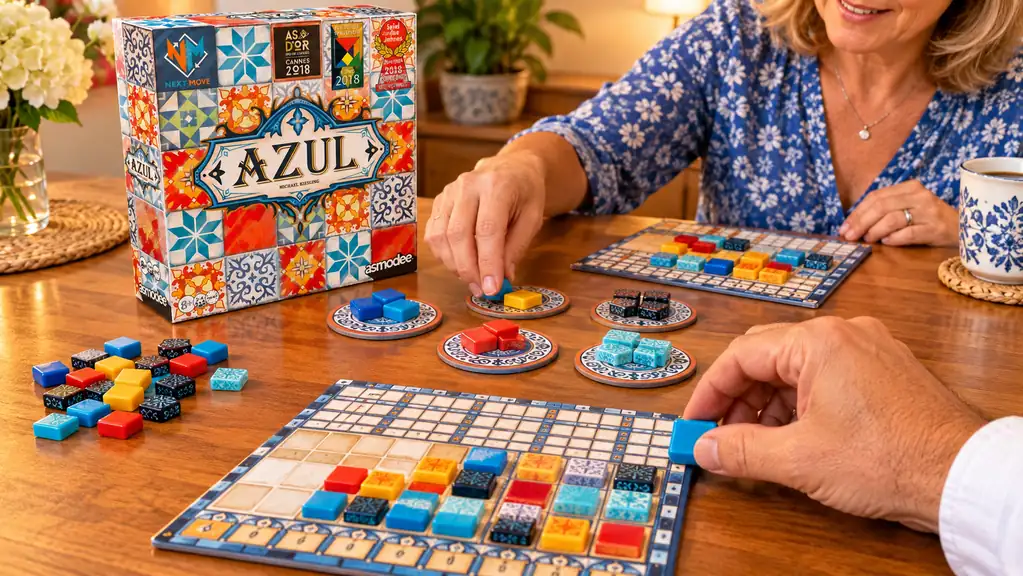
The pieces are heavier than I expected. Inside the box there are 100 resin tiles, four player boards, nine factory displays, four scoring markers and a starting player marker, and the tiles have a weight in the hand that makes them pleasant to shuffle around while you are thinking. The whole thing comes in at about 1150 grams, light enough to carry to a friend's house. If you have played a game where the pieces feel like cereal box cardboard, you will notice the difference the second you open it.
What Nobody Tells You About the Draft
Here is the part I would want a friend to tell me before I gave up an evening to it. Azul is not really a game about building a pretty mosaic. It is a game about taking things away from the person sitting across from you, and it is dressed up politely enough that this takes a few rounds to notice. You pick tiles from a shared factory display. Whatever you do not take slides to the middle of the table, and whoever takes from the middle goes first next round and gives up points later. Every pick you make leaves something behind for somebody else, and you have to decide, every single turn, what you are willing to hand over.
In the first few games you play it as solitaire. You look at the displays, you see what fits your pattern rows, and you take it. Then one night Mark took a tile he did not need, purely so that I could not have it, and the whole game changed shape on me. The rules call this draft and deny. I call it the moment the gloves came off at my kitchen table. If you are the sort of couple where one of you takes things personally, know going in that this game hands you a legal, structured way to be a little bit mean to your favorite person.
That is also the part I love, and the reason I am bothering to write this. Thirty-one years in, we have plenty of conversations where we are both being careful and polite. Azul gives us something small and low-stakes to be competitive about, and we laugh more in one round of it than we do across most of what is on television. It is not therapy and I would never sell it that way. It is a game. But a game that makes a quiet man defend his choices out loud is doing something worth naming.
He took a tile he did not need, purely so I could not have it, and the whole game changed shape.
The Scoring Is Harsher Than It Sounds
Nobody warns you about the scoring. During play you fill pattern rows on your player board, and each row you complete moves one tile onto your mosaic wall. Points come from the tiles already sitting next to where that tile lands, which rewards you for building outward from the middle of the wall instead of scattering tiles wherever they happen to fit. That much is straightforward and I picked it up in a single game.
The sting is in the penalties. Tiles left sitting on your player board at the end of a round cost you points, and taking from the middle of the table costs you points, and either one can quietly undo a round you were feeling good about. Our first three games, Mark won by a wide margin and could not explain why. The fourth game I stopped watching my own board and started watching his, and I worked out that he had been taking fewer tiles overall and letting me overfill my rows. He was not being generous. He was letting me build something I could not finish.
I have since returned the favor and I will admit it is very satisfying. What I would tell you is to read the scoring section of the rules twice before your first game. Not because it is complicated, but because it is the part that decides who wins, and it is the part everybody skips when they are eager to start pushing tiles around.
Two Players or Four? An Honest Answer
The box says two to four, and I have now played both ends of that range enough times to have an opinion worth passing on. Two is tighter and meaner. With two players, every factory display you empty matters more, the deny part of the draft lands harder because there is only one person to deny, and the whole thing is over in about half an hour. Mark and I play two almost exclusively and I would not change it.
Four is a different game, and for some groups a better one. With four, the displays empty faster and you have far less control over what actually reaches your turn, so it becomes more about adapting to what is left and less about planning three moves ahead. Our Thanksgiving game included two adults who do not play games at all. Both of them finished the round and asked to play again, which tells you how quickly the rules click for a newcomer who is willing to sit still for ten minutes of explanation.
Why the Rules Are Easy and the Game Is Not
The age on the box is eight and up, and I believe it. There are a handful of things you can do on your turn and the sheet that explains them fits on one page. That is why the game won the 2018 Spiel des Jahres, the German game of the year prize, which tends to go to games a family can teach at a table without a fight breaking out. The complexity in Azul is not in the rules. It is in the decisions, and those take a while to see clearly.
What that means in practice is that the first game and the tenth game are not the same game. Early on you are learning the shape of the board and where points come from. Later you are counting what is left in the displays, tracking what your partner seems to be collecting, and making choices that will annoy them two rounds from now. That gap between easy rules and deep decisions is the whole trick of a family strategy game, and Azul pulls it off better than most of what we have tried.
How We Play It Now
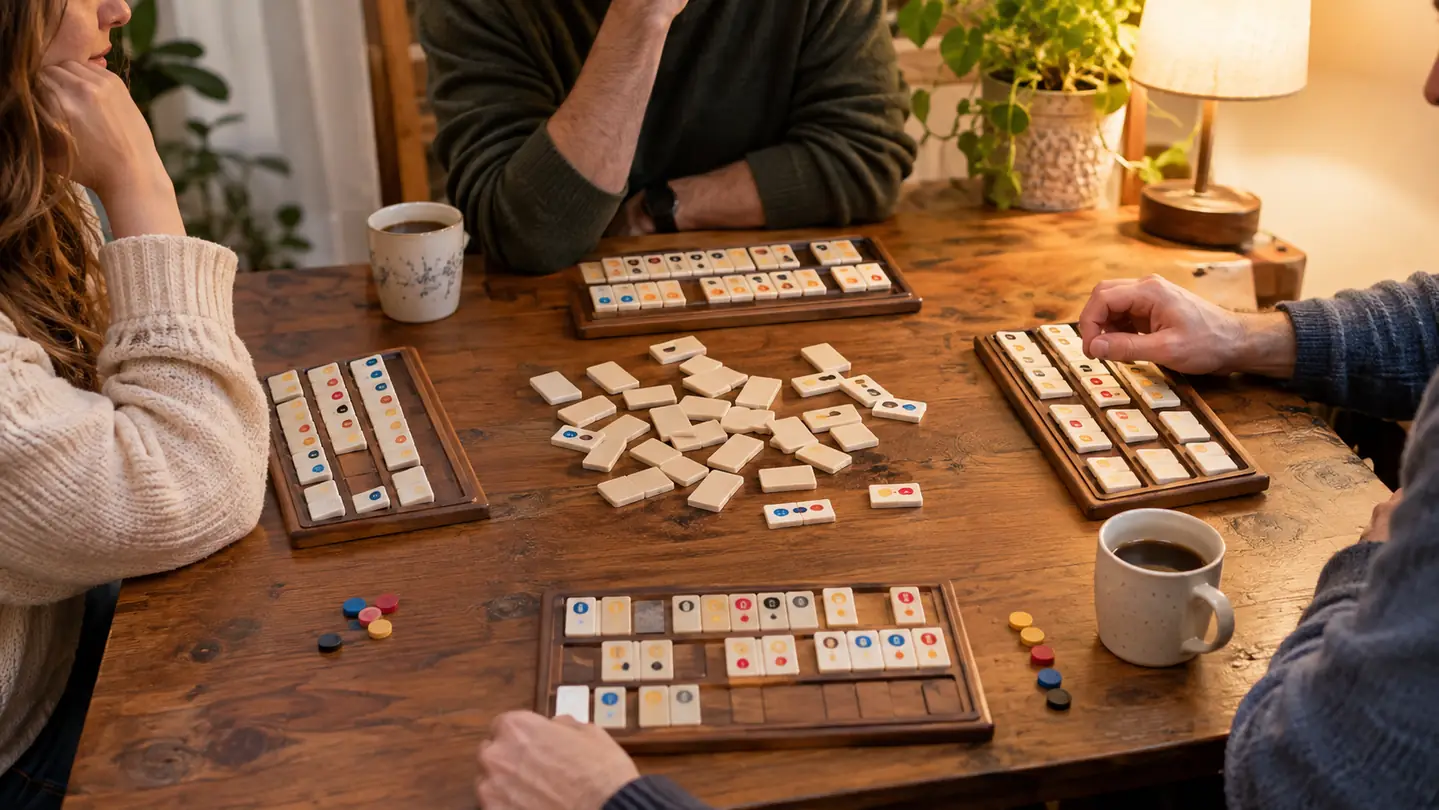
Thirty-odd plays in, we have settled into a version of Azul that is ours. We play two rounds instead of one, which takes about an hour including the scoring, and we keep a running tally on the back of an envelope in the kitchen drawer. Whoever is behind at the end of the month picks the takeout. It is a small thing and it has done more for our Fridays than any restaurant we have tried in the last three years.
We also stopped playing on the sofa. This sounds silly, but the game needs a flat surface with room for nine factory displays plus two player boards, and playing on the coffee table meant tiles kept sliding onto the rug in the middle of a round. The kitchen table is the right size for it. If your only table is small, look at the space before you buy, because this is not a game that tolerates a cramped surface and a plate of snacks crowding it.
And we keep it out. That is the real endorsement. Azul lives on a shelf in the kitchen, not in the closet with the other boxes, because the gap between deciding to play and actually playing is about ninety seconds. Every game we have ever owned that lived in the closet stopped getting played. That has less to do with Azul than with us, but it is the reason this one stuck when the others did not.
Where Azul Fell Short at Our House
I promised you the honest part, so here it is. Azul is not a talking game. If what you are shopping for is something that gets the two of you talking about your lives, this is a different animal entirely. It will get you interacting. It will not get you talking about your childhood or your five year plan. You will spend long stretches looking at tiles instead of at each other, and some nights that is exactly what you want, and some nights it is not what you needed at all.
The other honest thing is the ceiling. We have played it somewhere north of thirty times now and we can both feel the edge of it. It is a very good game. It is not an endlessly deep one. If you play the same box every single week for a year you will get tired of it, and that is not a knock on Azul so much as a fact about any single game. Play it once or twice a month alongside other things and it will hold up for years.
And a smaller complaint, since I am being thorough. The scoring at the end of a round is the only part of the evening where one of us is doing arithmetic out loud while the other waits. It is not long. It is just the least pleasant minute of an otherwise pleasant hour. If I could change one thing about the box, that is what I would change.
What I Liked
- Rules take about ten minutes to read and five to teach
- Two players and four players both genuinely work
- The resin tiles feel substantial in the hand and weigh about 1150 grams as a set
- The draft and deny mechanic gives quiet couples something real to compete over
- A round runs 30 to 45 minutes, which fits a weeknight
Where It Falls Short
- Quiet by design, so it will not start conversations about anything else
- Scoring penalties can undo a round you were feeling good about
- Not a game you pull out for a quick fifteen minutes
- Thirty plus plays in, you can feel the ceiling
Who This Is For
This is for couples who want a shared activity more than a shared conversation. If you and your spouse can sit across a table and be quietly competitive for half an hour, and if one of you is willing to learn the rules well enough to teach them without sighing, Azul is one of the better things you can put between you. It is also a genuinely good fit for a group of four, especially a group that includes somebody who insists they do not like board games. That person will be the one asking for a second round.
Who Should Skip It
Skip it if what you are actually after is a deck of prompts that gets you talking, because this is not that and it never will be. Skip it if either of you handles losing badly, since the deny mechanic means somebody gets picked on and it will not always feel fair. Skip it if you want a game with a decade of expansions and endless depth. And skip it if laying out nine factory displays and a hundred tiles on a Friday night sounds like a chore rather than a ritual. That is the honest cost of the box, and only you know whether your Fridays can carry it.
Thirty Plays In, It Still Comes Off the Shelf
Two players, thirty minutes, one kitchen table. If you want the game my husband reaches for without being asked, this is it. Current price is on Amazon.
Amazon Check Today's Price on Amazon →