

It took one Friday night to see that these two decks are not really competing for the same spot on the table.
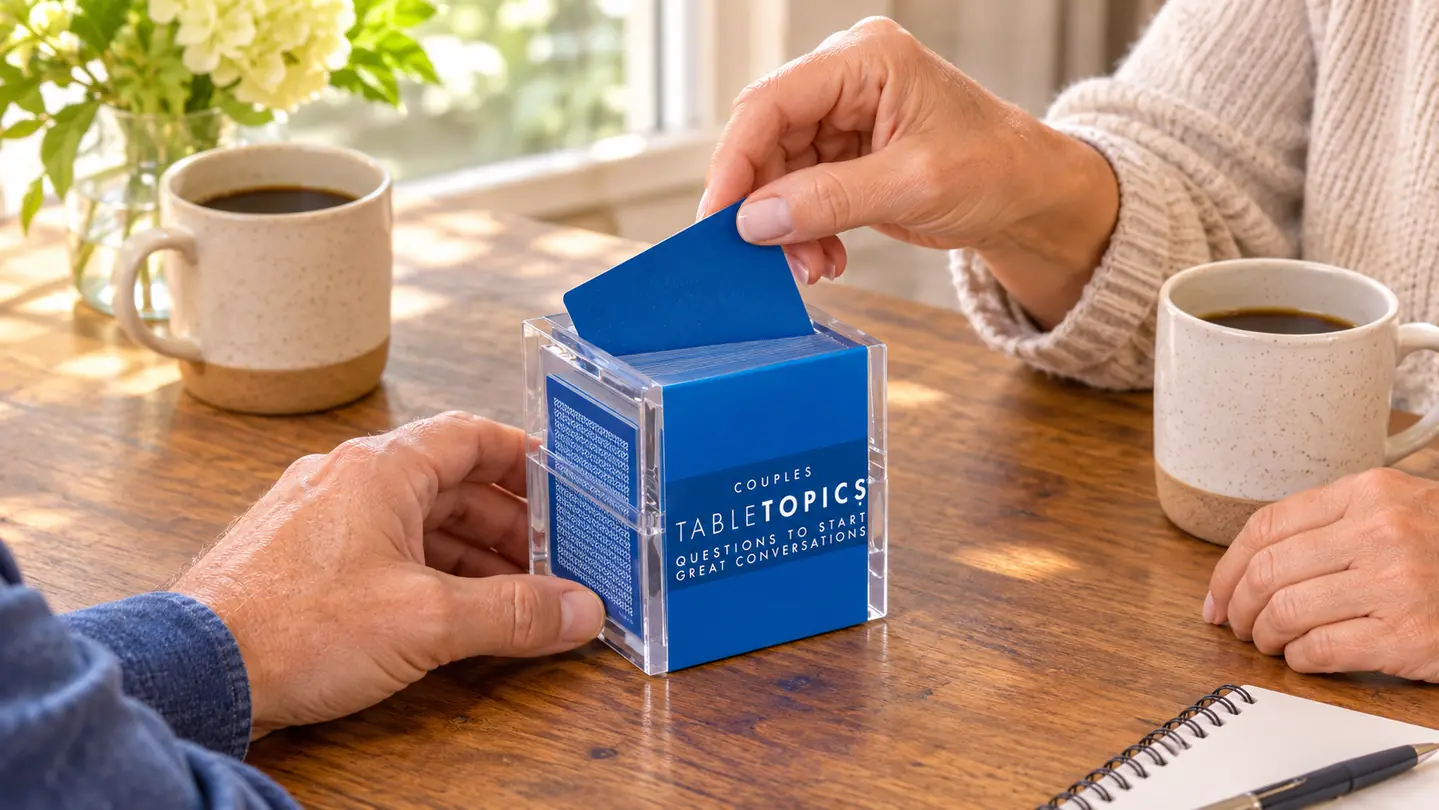
We're Not Really Strangers came out of the box first. Mark and I had one of those conversations that leaves you quiet afterward in the good way, where you keep turning something over for the next two days. TableTopics Couples came out the following week and we spent an hour and a half on the summer we drove up to Flagstaff with a broken radio, and on whether we would have liked each other at nineteen, which is a question neither of us had ever thought to ask. Both nights were good. They were not the same kind of good.
That is the whole difference, and it shows up in about ten minutes of playing. One deck builds something that is not there yet. The other goes back over something that already is.
So here is the short answer for anyone with three decades of marriage and a limited supply of Friday nights: TableTopics Couples is the deck that will still be in your house in three years and still get used. We're Not Really Strangers is the sharper deck, and for the right couple at the right moment it will do more in one sitting than TableTopics does in a month, but it runs out. I am not going to tell you one of them is correct for every marriage. One is a conversation starter built to age with you. The other assumes there is still an enormous amount you do not know about each other, which is true for new couples and less true for two people who have been splitting a mortgage since the nineties.
| TableTopics Couples | We're Not Really Strangers | |
|---|---|---|
| Cards in the box | 135 sturdy cards in a clear plastic cube | 150 cards split into three levels |
| Structure | No levels and no order. Draw a card, answer it. | Three levels built to escalate from lighter prompts to harder ones |
| Tone of the prompts | Warm and everyday, memories, preferences, small reveals | Pointed and feelings first, several cards land hard |
| How it holds up in a long marriage | Questions stay answerable for years because the history keeps changing underneath them | Many cards read as first-year material and get retired fast |
| Setup | Open the cube and draw | Open the box and work through the levels in order |
| Handling a heavy topic | Stays light and will not corner you | Goes straight at the thing you have been avoiding |
| Storage | The clear cube sits out on a shelf or the coffee table | A box that goes back in the closet |
| Best suited to | Couples who already share a long history | New couples, first dates, mixed groups of adults |
Where TableTopics Couples Wins
TableTopics Couples wins on the one thing that matters most for a long marriage: the questions assume a shared history instead of a blank slate. The card I keep coming back to asks whether it is our similarities or our differences that attract us to each other. I have answered that question three times now and given three different answers, and none of them were wrong. A deck built for strangers cannot do that, because a stranger only has one answer available.
The second advantage is stamina. There are 135 cards in the cube, cardstock and plastic, the kind that survives being handled by somebody who is not gentle. We have had this deck long enough that we have hit repeats, and we do them anyway, because the answer depends on what year it is and what we are currently annoyed about. A deck with one good night in it is a novelty. This is the other kind.
There is a card in the cube about the first apartment we rented over on Dobson Road, and the question is not really about the apartment. It is about what the two of us were like inside it. I pulled that one on a Friday in March with the oven still on, and we ended up talking for forty minutes about a couch we bought used and hauled up a flight of stairs in the heat. Mark remembered the color of it wrong. We argued about the color. That is a nothing conversation, and it is also the exact kind of conversation we had quietly stopped having somewhere around 2010, which is what a deck like this is actually for. Nothing got resolved. Nothing needed to be.
It is also the easier one to leave out. The cube sits on the shelf by the coffee maker, 1.4 pounds of cards in a container that looks fine in a kitchen, nothing to charge and nothing to keep score of. Mark can pull one card while the coffee brews and that counts as a game. For two tired people in their fifties on a Friday, that low barrier is most of the reason it gets played at all.
Where We're Not Really Strangers Wins
We're Not Really Strangers wins on structure, and I will say that fairly. The 150 cards are split into three levels, and the levels are built to escalate, which means the deck does the difficult part for you. If you have ever sat across from your own husband wanting to ask something real and failed to find a way in, a card already lying face up on the table removes the awkwardness. It got us to a genuine conversation in about ten minutes.
It also wins on the things couples steer around. TableTopics is polite. We're Not Really Strangers is not, and for a couple that has been coasting on logistics for a while, the pointed cards are the ones that do the work. I flinched at two of them. Mark answered one honestly enough that I was still thinking about it on Sunday afternoon.
The level three cards are where it earns its reputation. We worked up to them across two evenings because the deck asks you to, and the jump from level two is real. One of those cards asks you to name something you have never told the other person, and I will be honest that I sat with it a while and then passed, and Mark did not pass. What he said took me about three days to fully hear. I do not think there is a card in the TableTopics cube that could get a person to that particular sentence. That is a genuine advantage and it is not a small one.
Where it loses ground is that the sharpness does not renew. Once you have answered the level three cards, you have answered them. It is a good tool for a specific moment, the first year, or a rough stretch, or two people who just met and are deciding whether to keep going. It is not the thing you will still be drawing from in 2031 with the same person, and I do not think it is trying to be.
The deck that is still getting played in year thirty-one
135 cards, no rules, nothing to charge, and enough of them that you will not burn through it in a month. TableTopics Couples is the one that stays on the shelf instead of the one that gets a single good night.
Amazon Check Today's Price on Amazon →How These Two Ended Up on My Table
We live in Mesa, Arizona, and game night is Friday at the kitchen table, sometimes out on the patio when the evening finally drops below ninety. Mark runs service for an HVAC company, so by Friday he has spent five days being patient with other people's problems and has very little patience left for a rulebook. That is context, not a complaint. It shapes which games get played twice.
Before either of these decks, we tried a trivia game and it died in twenty minutes. Mark knew every answer and I knew the movie ones, and by the second round it had turned into a scoreboard. That is the failure mode for us. Anything with points turns Friday night into a competition, and I have been married long enough to know I do not need a formal structure for losing an argument. The conversation decks were a deliberate turn away from that. No scoring, no teams, nothing to win, nothing to be eliminated from.
The empty nest is what started it. The kids moved out and the house got quiet in a way that took me about a year to stop hearing, and Friday night turned into the two of us eating something and watching something and calling that a date. So we started testing conversation decks, both of these included, six weeks in a row, alternating. My only rule was no phones at the table.
What I paid attention to was not which deck we enjoyed in the moment. It was which questions we were still arguing about on Tuesday. That test sorts decks fast. Two cards from We're Not Really Strangers and maybe a dozen from TableTopics were still in the air two days later, and the TableTopics ones kept coming back around for weeks, which is the whole point of keeping a deck on a shelf.
One practical note on our setup. We played the We're Not Really Strangers nights indoors with the overhead light on, because you cannot read level cards by patio light and squinting breaks the mood. The TableTopics cube went outside with us all summer without a problem, since a card is a card and there is nothing to sort through. Small thing. It is the reason the cube got pulled out on a Tuesday in September and the other box stayed in the closet until we planned an evening for it.
I am a retired middle school English teacher, not a counselor, and I am not going to claim a card game repairs anything. No deck fixes a marriage. A good deck makes the ordinary conversation a little less lazy, and that is a small thing that compounds over a couple of decades.

What I'd Change About TableTopics Couples
The listing says 21 and up and two players, which is honest and also narrow. This deck does nothing for a dinner party, and if you were hoping to hand it around a group of six, buy something else. A handful of cards also circle the same territory closely enough that I would have cut one of them. And the warmth is a design choice with a cost: it will not push you toward the conversation you have been avoiding. That is what the other deck is for.
Two of the 135 cards are close enough in spirit that I pulled one out and left it in the drawer, and I do not feel bad about it. The cards also arrived packed tight enough that the first few pulls were a small fight, which annoyed me more than a thing like that should. Neither of those is a reason to skip it. I have since handed the cube to two other couples at our table and heard the same two notes back from both of them, so I know it is the deck and not just me being fussy.
What I Liked
- 135 cards that hold up to years of handling
- Questions assume shared history, so they stay answerable as the marriage changes
- No rules, no scoring, no charging. One card is a complete game
- The clear cube lives out in the open instead of going back in a closet
Where It Falls Short
- Two players only, so it is useless for a group night
- A few cards repeat a theme closely enough to feel redundant
- Warm by design, which means it will not corner you into the hard conversation
- Somebody has to start it. Nobody deals you in.
We have answered the similarities question in three different decades and given three different answers, and none of them were wrong.
Who Should Buy Which
Buy TableTopics Couples if you have been together long enough that you have stopped asking each other new questions. If Friday conversation has become a recap of the week and a decision about the weekend, this is the deck that interrupts it. It is also the one to buy if you want something still in use after the novelty of a new game wears off, which in this house is about three weeks.
Buy We're Not Really Strangers if you are in the first year or two, or if you have hit a stretch where the two of you are polite roommates and one honest card is worth more than six months of hinting. It is the better engagement gift. It is also the better deck to bring to a table of adults who do not all know each other, since the level system gives a group somewhere to start.
If you are buying for somebody else, the safer gift is We're Not Really Strangers, because it travels better. I gave one to my niece when she got engaged and it was the right call for two people in their twenties who have not yet run out of things to tell each other. The TableTopics cube is the gift I would give to a couple that has been at it fifteen years or more, the ones who already own a slow cooker and do not need another object in the house. It reads as a gift that thought about their situation instead of a gift that was on sale.
If you are buying one deck for a marriage that is already twenty or thirty years deep, buy TableTopics. Not because it is the better game in the abstract, but because it fits the marriage you actually have. We're Not Really Strangers is a good deck for a beginning. TableTopics is the one for the middle, and the middle is where most of a marriage happens.
Give your Friday night a better first question
135 cards in a clear cube, two players, no rules to learn. Ours has been sitting out for years and it still gets pulled down off the shelf.
Amazon Check Today's Price on Amazon →