

Mark and I started Friday game nights the week our youngest moved out. That was four years ago, and the kitchen table in Mesa has hosted a lot of boxes since. Most of them fall into two piles: the ones we still bring up at brunch and the ones that went to the donation bin by Sunday. I Should Have Known That! from Hygge Games sits closer to the first pile, but not for the reasons the box suggests, and I want to be straight with you about the parts that made me groan as well as the parts that made me laugh.
The short version: it is a small paper box holding 110 cards and more than 400 questions, it teaches in under a minute, and it got my husband Mark, who is 58 and manages an HVAC service crew, to sit back in his chair three times in one round and say the name of the game out loud like a confession. It also has a scoring rule that takes a full round to feel right, and a player count that caught us flat on our first night at home alone. Both of those are worth knowing before you buy, and neither one makes it to the front of the box.
The Quick Verdict
Sharp, portable, and built to make grown adults feel silly in the best way. It wants three or more players, and the scoring takes a round to click.
Amazon Check Today's Price →The card game that made my husband admit he did not know
110 cards, more than 400 questions, and one rule that flips who wins. See today's price and the current reviews on the listing.
Amazon Check Today's Price on Amazon →How I've Used It
We have played it eleven Friday nights since March, plus one afternoon on the back patio in April when the weather finally broke, plus a dinner at a friend's house where it came out of my tote bag before dessert. Our usual table is four adults: me, Mark, and whichever couple we have talked into coming over. Twice it has been six. Once it was seven, and that round got loud enough that Mark closed the kitchen window so the neighbors could keep their opinions to themselves.
Setup is nothing. You open the box, you square up the stack, you argue about who goes first, and you start. There is no board, no timer, and no bag of pieces to lose behind the stove. The whole thing weighs 8.8 ounces, so it lives in a tote bag next to my reading glasses and travels to a restaurant without any ceremony at all. For a game night that starts at seven on a Friday after a long week, that matters more than I expected it to.
The cards are paper, and after eleven nights the top card of our stack has a soft corner and a faint coffee ring. That is not a criticism, just a durability note for anyone planning to play weekly for a year. This is a stack of cards in a box, built like a stack of cards in a box, and it will look like one after a while. I have owned sturdier games that were less fun, and flimsier ones that got exactly as much use out of us.
What surprised me is how little downtime there is. In a lot of trivia games you sit through somebody else's turn reading a long question to themselves first. Here the card gets read out loud, everybody commits to an answer, and the next card is already coming. On a night when we have four people and two hours, that pace is the difference between three rounds and six.
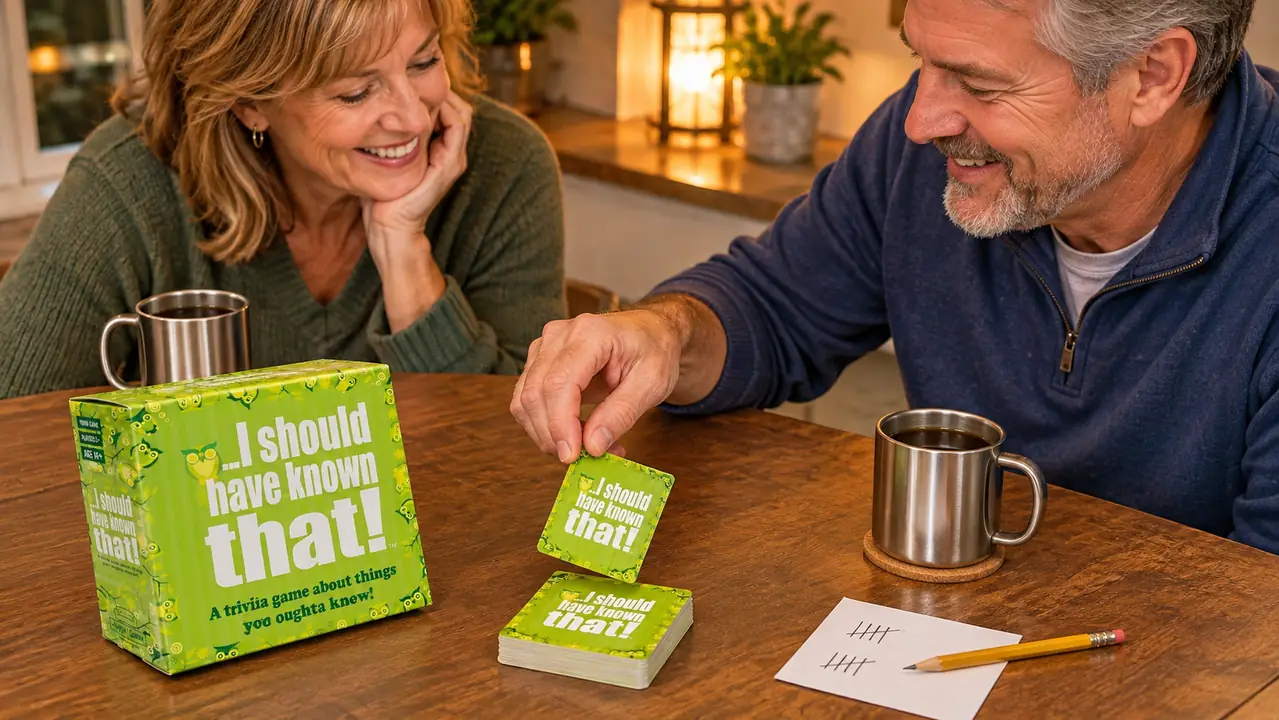
The Scoring Reversal, and the Round It Finally Made Sense
Here is the thing Hygge Games built the game around, and it took our table two rounds to stop fighting it. In a normal trivia game you collect points for being right. Here, being right does not move your score. The points come from the other direction entirely, which sounds like a small twist on paper and behaves like a different game at the table. The first night, the couple we had over kept answering correctly and kept sitting on nothing, until one of them put her card down and asked whether we were being punished for paying attention in school.
By the second round it clicked, and the mood changed. Everyone stopped performing. Nobody was showing off the one fact they happened to remember from a documentary they watched in 2011. The whole group was wrong together, on the record, out loud, and that turned out to be more fun than a quiz night where one person quietly wins and everybody else watches them do it. My husband, who is competitive in a way that has ruined other games for us, actually relaxed.
We keep a pen and a scrap of paper by the stack for the tally, which has become part of the ritual. If your group argues about scorekeeping, appoint one person early and let it go, because the number at the end is not really the point. The retelling the next morning is the point. I have heard Mark tell the same wrong answer to his brother twice on the phone, and he tells it better the second time.
One more note about the reversal, because it changes behavior: people answer faster. In a normal game you watch somebody hesitate and you know they are calculating whether to risk it. Here there is no penalty for being wrong and no reward for being right, so people say the answer out loud and commit to it. That lack of stakes is what makes the table loose and funny instead of tense.
What Nobody Tells You: It Genuinely Wants Three or More
The box says more than two players, and that is accurate, and it matters more than the listing makes it sound. On our first Friday, before anyone arrived, Mark and I tried to play with just the two of us. It went flat in about ten minutes. The design depends on a group hearing the same question at the same time, one person landing it, another person missing it, and the table reacting to both. With two people there is no table. There are just two people being quietly wrong at each other.
Our house rule for the two of us: we each take two answer slots and score the lower one. It works well enough that we still play on the odd week when nobody comes over. But it is not the game as written, and I would not tell a couple to buy this for cozy two-person nights without saying that up front. That is the single most useful thing I can pass along to somebody standing in a store trying to decide.
With four people around the table it is close to perfect. With six it gets better, because there are more chances for somebody to miss something obvious. With seven you will want to split into two teams, or the far end of the table will not hear the question and will spend the whole night asking everyone to repeat it.
Eleven Friday nights, four to seven adults, and the round we retell at brunch is always the one where somebody missed something they have known since the fourth grade.
How It Compares to a Normal Trivia Night
When we play a standard trivia game, the same two people tend to win and the same two people tend to get quiet by the third round. That is not a knock on anybody. It is just what happens when a game keeps score on knowledge. This one spreads the winning around, because the person who knows everything is not the person the scoring rewards. In eleven nights we have had six different people come out on top, and one of them insists she is terrible at trivia.
What you give up is the satisfaction of a clean right answer being worth something. Some people want that. Mark wanted it for the first hour, and then he stopped wanting it, and now he defends the rule to guests before I have finished explaining it. Your mileage will depend on how many people at your table need to be right in order to have a good time.

What Actually Made Us Laugh
The questions are aimed at adults who have been alive long enough to feel foolish for missing them. That is the engine of the whole thing. There is a particular laugh that comes out of a grown adult who has just missed something a teenager would get, and this game produces it over and over without ever feeling mean. Nobody is being exposed. Everybody is in the same boat, and the boat is full of things you should have known.
The 400 plus questions spread across 110 cards means each card holds several questions and can carry a whole round or get passed around the table. We have played eleven nights and have not hit a repeat yet, which says something about how much is packed into a box this small. If you play once a month, it will last you years.
It is also the most portable game on our shelf. Patio, kitchen table, the back booth of a diner while we waited on food. At 8.8 ounces it takes less bag space than a paperback, and there is nothing to set up once you sit down. We took it to a birthday dinner and it kept four adults occupied for forty minutes while we waited on a table, which is more than I can say for the phone games everyone else was playing.
The best nights are the ones where somebody gets a question wrong, argues that the question was unfair, and then gets the next one wrong too. There is a rhythm to it. Wrong, defend, wrong again, and the whole table goes. That rhythm is not something you can put on the box, but it is what we keep coming back for.
The Parts That Grumbled
The scoring reversal is clever and it is also the thing I would change if I could. In a mixed group where two people are strong trivia players and two are not, the strong players spend the night not being rewarded for what they know. One of our regulars said it felt like being graded on a curve in the wrong direction. She laughed all night. She also brought it up twice, and I do not think she was joking the second time.
The box is plain. No board, no timer, no inserts, nothing to sort. If you like a game that looks like something on a shelf, this is a stack of cards in a paper box and it will never be more than that. That does not bother me. It might bother you, and I would rather say so now.
The age range is right at 14 and up. This is not a game to hand to a table with young kids, partly for the reading and partly because several of the questions land better with people who have driven a car and paid a bill. We tried it once at a table with younger children and they drifted off inside a single round, which is not the game's fault and not theirs either.
None of this is a knock on Hygge Games so much as a map of where the game fits. The frictions are small and they are consistent. If your table is three or more adults who like laughing at themselves, you will not notice most of what I just wrote, and you will wonder why I bothered mentioning it.
What I Liked
- Teaches in under a minute with no board, no timer, and nothing to lose
- More than 400 questions across 110 cards, and no repeats in eleven nights at our table
- Small and light enough for a restaurant booth or a patio
- The reversed scoring gets everybody laughing together instead of one person winning quietly
- Handles four to seven adults without any rule explaining at all
Where It Falls Short
- Two players is not enough as written, we had to invent a house rule
- Strong trivia players get nothing for being right
- Paper cards will soften and stain with weekly play
- You will want a pen and paper for the tally
- Not built for tables with young children
Who This Is For
Couples and friend groups who already enjoy being wrong in front of each other. Families with teenagers who can hold their own at a table. Anyone who has hosted a game night and watched the energy drop when the rules explanation hit minute twelve. This one explains in under a minute, and the first laugh usually lands on the first card, which is faster than almost anything else in our cabinet.
It also suits people who want a game they can carry. If your version of a date night is a booth at a diner rather than a table at home, this fits in the tote and needs no flat surface beyond the one you already have. I have brought it to two restaurants now and neither one minded.
Who Should Skip It
Skip it if your game nights are two people. The listing says more than two players and means it, and our workaround is a workaround, not the design. Skip it too if your group has somebody who cannot stand being wrong in front of others, because the whole game points a light at that person and keeps it there all night.
And skip it if you want a game that rewards expertise. This one does the opposite on purpose. If that reads as funny to you, you will have a good Friday. If it reads as irritating, it will be irritating right up until the box goes back on the shelf.
A small box, four hundred questions, and one rule that flips the table
If your Friday needs a game that explains itself in a minute and travels in a tote bag, this is the one we keep reaching for. Today's price and the current review count are on the listing.
Amazon Check Today's Price on Amazon →