
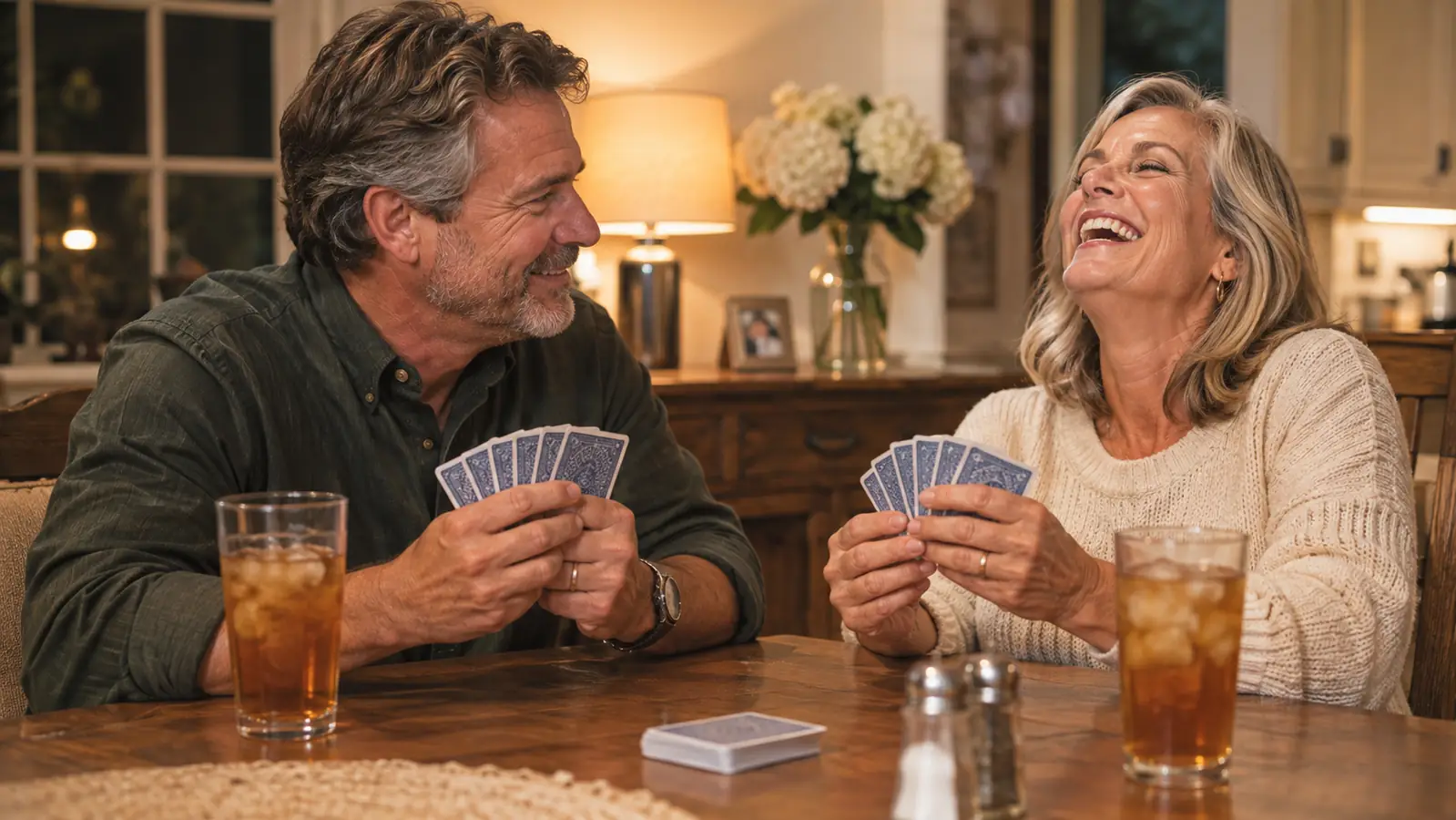
Mark and I have been married thirty-one years. Somewhere around year twenty-eight, our Friday nights turned into two people scrolling separate phones at the same kitchen table. So we started buying trivia games, one box at a time, hoping something would stick. Most of them lasted a single round. Either the questions were built for a sports bar full of strangers, or they were so easy that nobody at the table had to think. I should have known that! from Hygge Games was the first one that got a second Friday out of us. Four months later the corners of the cards have gone soft and we still reach for the box.
Here is the thing that made me buy it in the first place. The listing says 110 cards and more than 400 questions, and then it says something genuinely unusual: you do not receive points for answering correctly. That one line changes how a whole table behaves. Nobody is performing. Nobody is quietly keeping a running tally of who is smarter. The pressure that kills most game nights never shows up, because being right is not the thing the game rewards.
The Quick Verdict
The rare trivia box that works for a married couple on a Friday and again for six people on a patio, because it stops rewarding the person who already knows everything.
Amazon Check Today's Price →The trivia box that does not hand the win to the loudest know-it-all
110 cards. More than 400 questions. Rated for ages 14 and up, and listed for more than two players. That is the whole pitch, and four months in, it is still enough.
Amazon Check Today's Price on Amazon →How I've Used It
We play on Friday nights, usually at the kitchen table, sometimes out on the back patio once the Mesa evenings finally drop below ninety. Mark is fifty-eight and manages an HVAC service crew, so he comes home tired and does not want a rulebook. I taught middle-school English for twenty-nine years before I retired, which means my tolerance for instructions that take longer to read than the round takes to play is basically zero. This one sets up in under a minute. Open the box, deal the cards, start reading.
We have played it just the two of us, which is our default. We have also played it with my sister-in-law and her husband, the kind of guests who will sit at a table for three hours if the food is good and the company is better. And we played it once with four neighbors on the patio, which was the loudest that patio has been since our youngest moved out and took the noise with her.
The pattern is identical every time. The first round is polite. The second round, somebody gets a question about something they have done a thousand times and cannot name, and the whole table turns on them. By the third round people are arguing about the answer before the card is even flipped over. That is the actual product here, not the questions. The arguing.
What's Actually in the Box
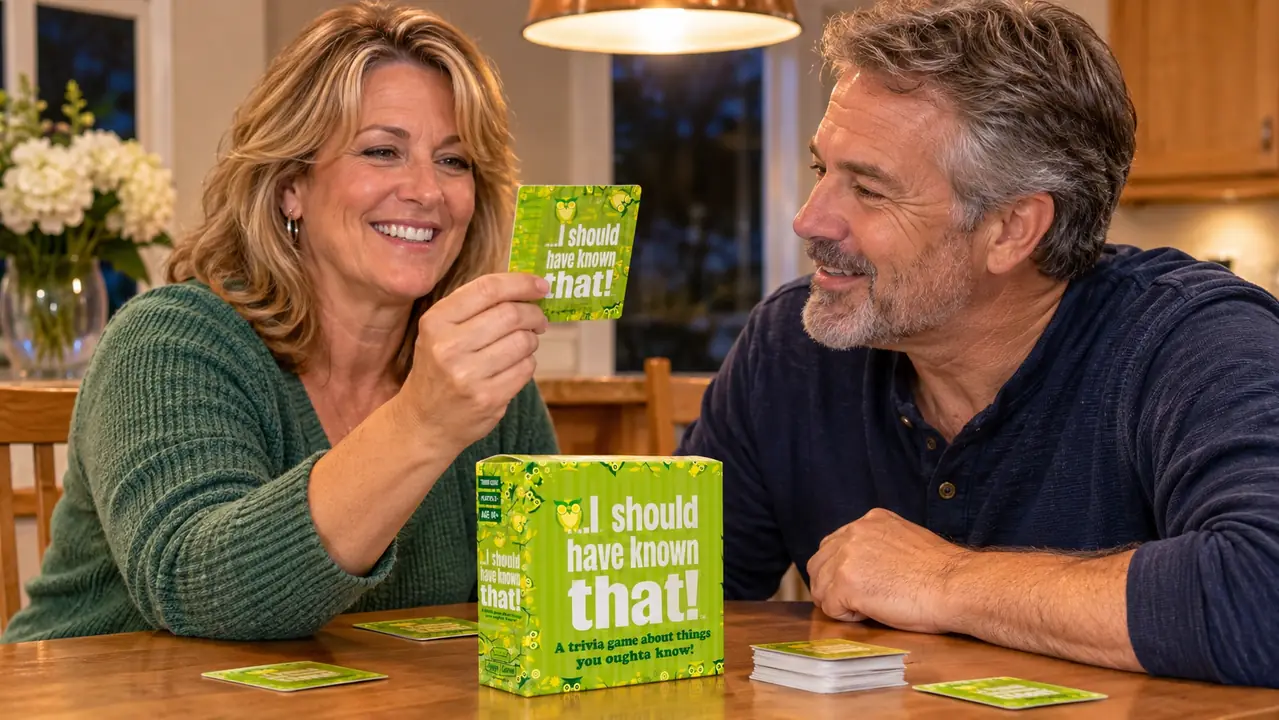
One small box, 110 cards, more than 400 questions, printed on paper, weighing 8.8 ounces. That is light enough to carry out to the patio or toss in a tote for a weekend rental. It is English only, rated for ages 14 and up, and listed for more than two players, though two works perfectly well. Everything lives in that one box, which matters more than it sounds like it should. The games that need a board and six kinds of pieces are the games we never bother to set up.
The questions are about ordinary things. That sounds like faint praise and it is not. Most trivia is built around facts you either studied or you did not, state capitals and presidents and which team won in 1987. This one leans on the stuff you have crossed paths with your entire adult life and never once had to put into words. Which is why the reaction at the table is almost always the same shape: a long pause, then a laugh, then some version of, I should have known that.
The 14-and-up rating is honest in both directions. A couple of cards reach for references a fourteen-year-old would catch and a seventy-year-old might not, and the reverse is just as true. I would not hand this to a table of mixed generations without expecting two or three duds a night. With adults in roughly the same decade, it lands almost every card.
The Scoring Runs Backwards, and That's the Point
I have watched a lot of game nights die in exactly the same spot. One person at the table knows everything. They answer first, they answer fast, they answer with a small satisfied nod, and by round four everyone else has quietly stopped trying. Trivia rewards recall. Recall is not distributed evenly and it never has been. That is a terrible foundation for a Friday night with your spouse.
Hygge Games built the opposite. You do not get points for answering correctly. I am not going to spoil exactly how a round resolves, because the first time through is genuinely better if you walk in cold. What I will tell you is that the scoring pulls the quiet people in. Mark, who will not volunteer an answer in a room full of people he does not know, has won more rounds of this than I have. My sister-in-law, who insists she is terrible at trivia, cleaned up on our second night.
The effect on a long marriage is small and real. For thirty-one years I have been the one who reads and remembers and corrects. For one hour on a Friday, being the one who reads and remembers is not an advantage. Mark finds this hilarious. I have made my peace with it.
For thirty-one years I have been the one who remembers everything. For one hour on a Friday, that is not an advantage, and Mark finds it hilarious.
The Round I Still Think About
It was a Sunday in June, just the two of us, patio door open, a fan moving hot air around the kitchen. Mark drew a card, read a question about something that sits in a drawer in every kitchen in America, and then went completely silent. I counted eleven seconds, because a retired teacher cannot help herself.
He got it wrong. He got it wrong in a way that was so confident and so specific that I believed him, and then the card said otherwise, and he put his forehead down on the table. We have been married thirty-one years. I have watched that man handle a burst pipe at midnight without raising his voice. A card about a kitchen drawer undid him.
That is the thing I keep coming back to. The questions are small enough that you feel you should know them, and specific enough that often you do not. The gap between those two feelings is where all the laughing happens. A question you cannot answer at all is boring. A question you nearly answered is the whole evening.
Where It Stalls
The first thing to know is that this is a warm-up, not an entire evening. A session runs shorter than you expect, and when we tried to stretch it into a two-hour main event, the energy dropped in the last third. It is better as the thing you play while the pizza is still on the counter and somebody is still standing up.
The second is reference drift. The 14-and-up rating is accurate in the sense that a teenager can play, but the questions assume a certain number of years on this earth. Playing with our neighbors, who are in their seventies, produced three or four cards that landed with a thud because the thing being asked about had never crossed their path. Nobody's fault. Just the reality of a single deck trying to cover everyone.
The third is that the game only works as well as your table is willing to argue. With Mark it sings, because he will defend a wrong answer to the death. With a couple we played alongside last month, one of whom answers everything in four words, the same cards fell flat. A box cannot manufacture personality. It can only give personality something to react to.
The fourth is physical. It is paper in a small box at 8.8 ounces, and after four months of Fridays the card corners have gone soft and the lid no longer snaps down the way it did in March. Nothing has torn. Nothing has been lost. It simply looks loved, and it will not be the game you pass down to anybody.

Two Players, Four Players, Six Players
Hygge Games lists this for more than two players, and the box is right to. Two works. It is what we do most Fridays. But the game is built for a table that can react, and two people is the minimum number required for a reaction.
At four it is at its best. Enough people that somebody will not know the answer, enough that somebody else will, and enough side conversation to fill the space between cards. At six it gets loud and slightly chaotic and you will want to split into teams, which we did on the patio in July and which turned a friendly game into something with actual stakes.
The one arrangement I would avoid is a big table of near strangers. The fun comes from the moment of recognition, and recognition is funnier when the people across from you have watched you forget your own phone number in a parking lot. Play it with people who know you.
What I Liked
- Does not hand the win to whoever already knows everything, so the whole table stays in the round
- More than 400 questions on 110 cards, so one small box covers a long run of Fridays
- 8.8 ounces and a single box means it goes to the patio, the rental, or the tailgate without a second thought
- Sets up in seconds and nobody has to read a rulebook twice
- Plays fine at two and gets better at four
Where It Falls Short
- Paper cards in a light box, so the corners soften and the lid loosens after a few months
- A handful of cards assume a specific generation, so mixed-age tables will hit duds
- It is a warm-up, not an entire evening
- Two quiet people will get less out of it than two people who like to argue
How It's Held Up Over Four Months
We started playing in the spring and the box has lived on the kitchen table ever since, more or less. Four months, roughly every other Friday, plus one patio night in July and a weekend when my sister-in-law stayed over and we played both nights. The cards have softened at the corners. The box has a crease along one side from being wedged under a chair. Nothing has torn. Nothing has gone missing. The questions still read clean.
That is about what I expect from a paper game at 8.8 ounces. It is not built to be an heirloom. It is built to survive being dropped in a tote bag and dragged out to a patio, and it does that without complaint. If you want something that looks like a coffee table object, this is not that object.
Who This Is For
Couples who have run out of things to say on a Friday and do not want to spend the evening on separate screens. Couples where one person reads constantly and the other one does not, and the reading one has been quietly winning at trivia for years without ever being called on it. Empty-nesters especially, because the silence in a house after the kids leave is a different kind of silence, and it takes a while to fill it with something other than television. And hosts who want a fifteen-minute icebreaker before dinner that does not require explaining rules to anybody.
Who Should Skip It
Skip it if your idea of game night is a six-hour campaign with a board and a rulebook. Skip it if you need something that scales to twelve people, because this does not. Skip it if you are buying for a mixed table of teenagers and grandparents and expect every single card to land, because a few will not. And skip it if you are looking for a game that keeps standings across a season, since the entire design argues that the round you are in is the only round that matters.
Four months in, it is still the box we reach for on a Friday
More than 400 questions, 110 cards, rated 14 and up, built for more than two players. It will not fix a quiet marriage. It will give a quiet Friday something worth arguing about.
Amazon Check Today's Price on Amazon →