
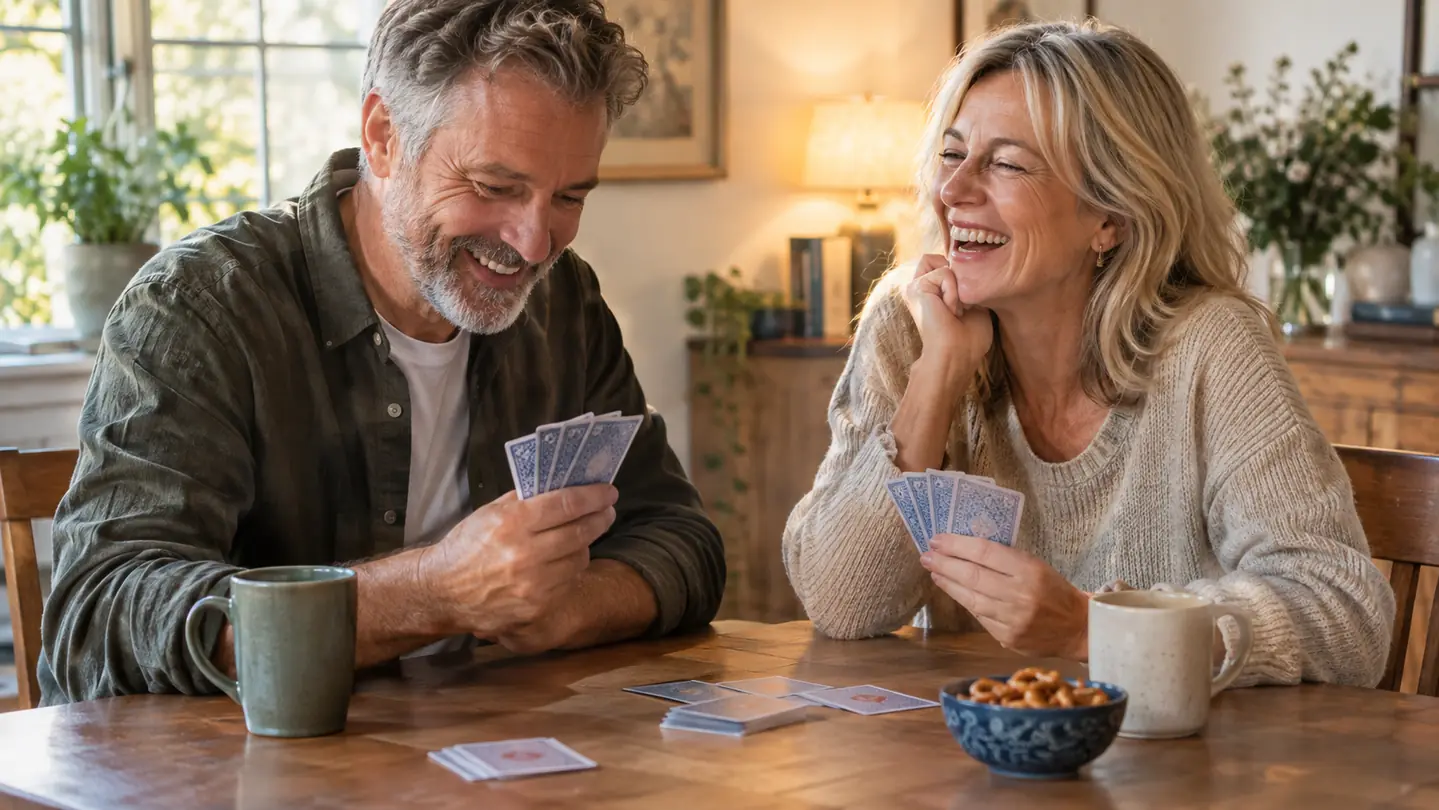
Mark and I have been married thirty-one years, and for most of them I would have told you trivia was not a couples activity. It was a party activity. You put it on a table at a barbecue and people drift toward it and drift away. Play it with just your husband and it turns into a scoreboard, and one of you is better at remembering the name of the second man on the moon and the other one is not, and now that is a thing sitting in the room with you on a Friday night.
Then a friend left a box called I Should Have Known That on our counter, made by Hygge Games, and I set it out one Friday mostly so it would not look like I was avoiding it. That was over a year ago. It is now the only game that has stayed in rotation at our kitchen table without anyone getting quiet and weird. What follows is the actual setup that got us there, five steps, in the order I would do them if I were starting over tonight.
The box that ended our scoreboard problem
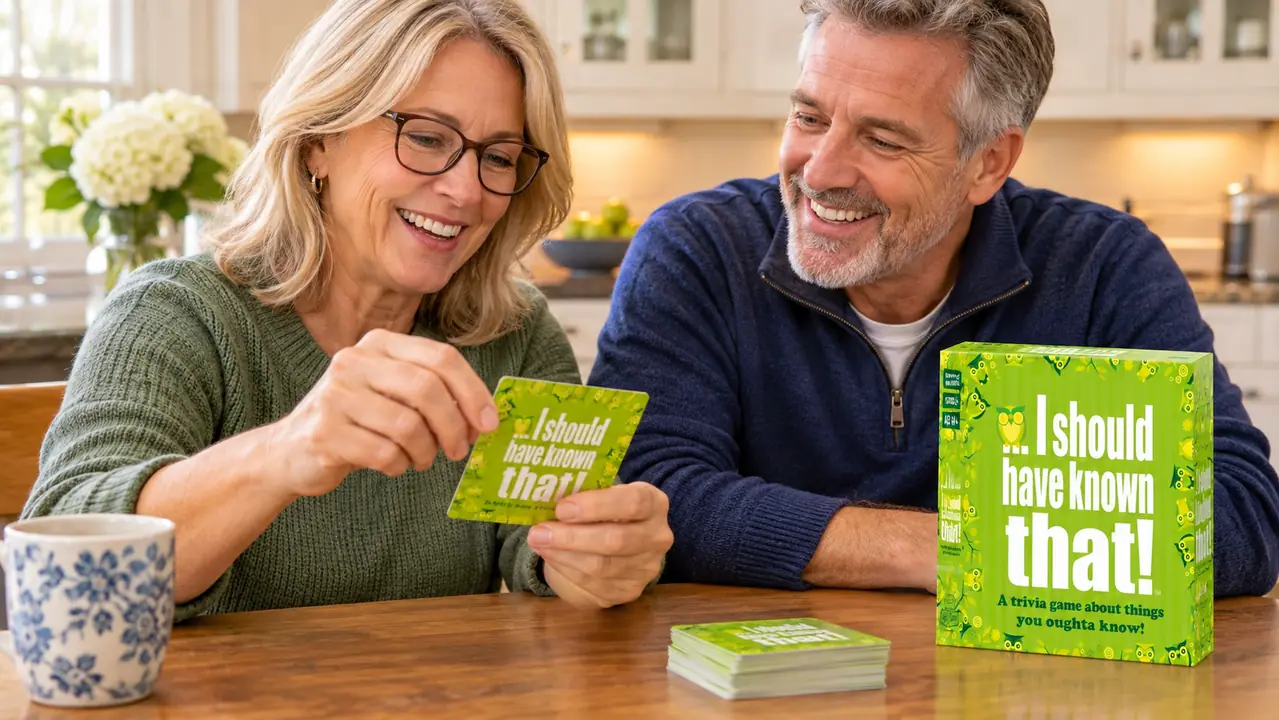
110 cards, more than 400 questions, and no points awarded for being right. That last detail is the whole reason Mark and I still play it.
Amazon Check Today's Price on Amazon →Step 1: Play the first round as a conversation, not a competition
This is the step I got wrong twice before I got it right. The instinct, when you open a trivia box with your spouse, is to divide into teams. Do not. Not the first night.
The first time we played, in January, I kept score on the back of a grocery receipt because I thought it would be fun to have a winner. Mark won by six. He was gracious about it, which somehow made it worse, and by ten o'clock we were in separate rooms reading. The second attempt, two weeks later, I did not keep score, but I did keep a running tally in my head, which is the same thing with better manners. What finally worked was the third Friday, when I left the receipt in the kitchen drawer and we just read cards to each other.
The reason that third try worked is the way I Should Have Known That is built. In the usual trivia format, a right answer earns points and a wrong answer earns nothing, so the game sorts you into a person who knows things and a person who does not. This one does not award points for correct answers at all. You read a card, you get the question, and the interesting part is the moment before the answer when one of you realizes you had no idea and the other one did. The card is a conversation starter wearing a trivia costume.
So the first round, treat it that way. Read the card out loud. Guess. React when the answer turns out to be obvious in hindsight, because it usually does, and the ahhh is the actual fun of the thing. Do not keep a tally on the back of an envelope, and do not say the word "point" for the first forty minutes. You are finding out whether the two of you like doing this together. You cannot find that out while you are also losing.
Step 2: Set the table like a date, not like game night
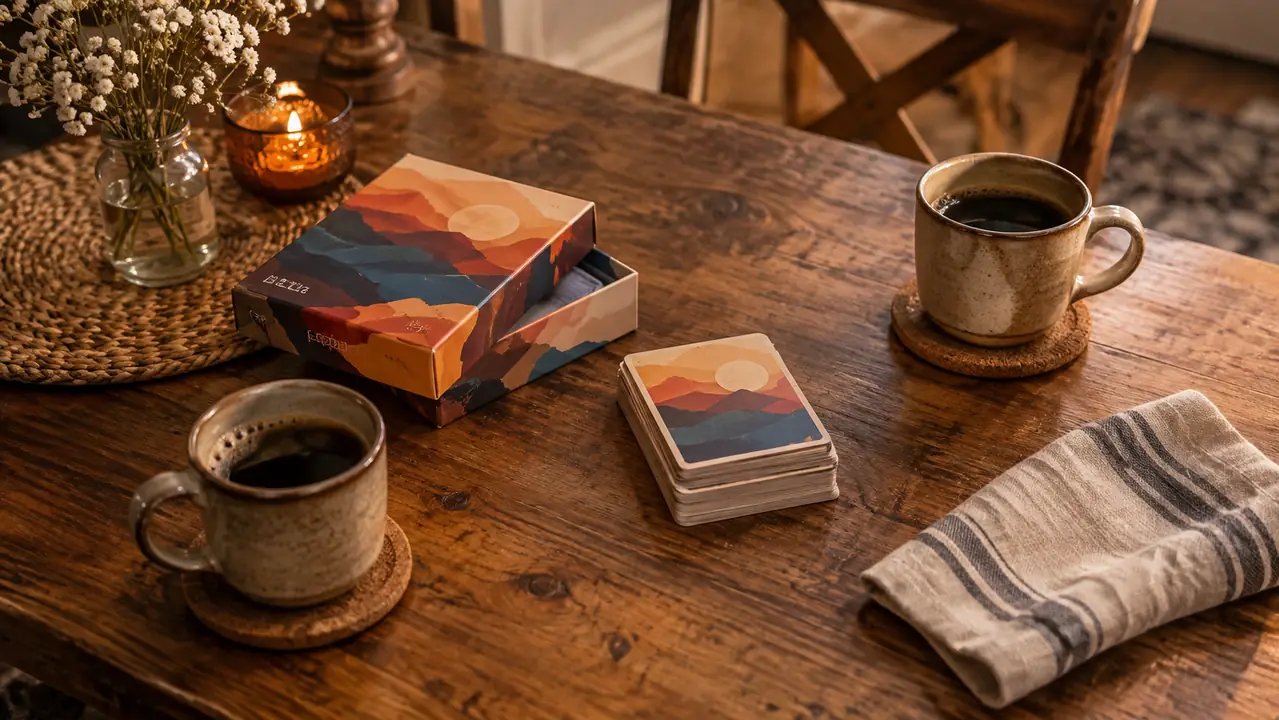
Our kitchen table has a specific gravity. If there is mail on it, we will sort mail. If there is a laptop on it, Mark will check a work ticket. So the table gets cleared all the way down, and it gets set the way we would set it for dinner.
For us that means two mugs and something small to eat, and the cards dealt into the middle of the table instead of left in the box. The Hygge Games box is small and light, under nine ounces, so it moves from the shelf to the table without becoming a project. There is nothing to assemble, no timer, no board, no pieces to count. I have had game nights die at the assembly stage. This one cannot die there.
We tried the back patio in July and it lasted about twenty minutes. The wind took a card off the table twice, and once you are chasing a card across a patio you are not on a date anymore, you are doing chores. We also tried the low coffee table in the living room one night in February, and that was worse. You cannot hold a card and a mug and sit on a sofa at the same time without setting one of them down, so every question turned into a small logistics problem. The kitchen table, cleared and set, beat both of them.
The other thing sitting at the table does, and this matters more than I expected, is put you facing each other. Thirty-one years in, Mark and I can go a whole evening in the same room and be looking at the same screen the entire time. Facing each other with a stack of cards between us is a different posture. It sounds like a small thing. It is not a small thing.
Step 3: Use the card count to time the night, not to finish the game
There are 110 cards in the box and more than 400 questions spread across them, which is enough for a lot of Friday nights. The trap is thinking you have to work through them. You do not. The box is not a to-do list.
One Sunday in March we decided to see how far we could get in a single sitting. We started at seven and by eleven we had been through most of the box, and neither of us could have told you three questions from the first hour. We had turned a game into a chore with a finish line, which is the opposite of what we were after.
What we do now is this. I pull somewhere between eight and twelve cards out and put them on the table, and everything else goes back in the box. When those are done, the night is done, or we refill if we are still having a good time. That single change fixed the thing that used to ruin trivia for us, which was the slow fade. The fade is when you are ninety minutes in and neither of you is enjoying it but neither of you wants to be the one who says so.
Eight cards takes about forty-five minutes for the two of us, sometimes an hour, because a question about something we ought to know will set off a story about a teacher or a trip or a person we have not thought about in years. That is the actual product here. The trivia is the doorway. The conversation is the room.
It has been the only game in the house that gets played without a score pad, a timer, or anybody watching the clock.
Step 4: Agree on the one rule before you start
Our rule: if a question opens a memory, we take the memory. We do not say "let's keep going." One card about a river sent us sideways for twenty minutes into a story about Mark's grandfather's boat, which I had somehow never heard in thirty-one years of marriage. That story was worth more than finishing the stack.
Say the rule out loud before the first card, because a rule that lives only in your head is a rule you will abandon the moment you are curious about what is on the next card. One of us says it, the other one nods, and then we start. It takes five seconds and it has saved the night more than once.
It also helps to decide up front what a wrong answer costs, and the answer should be close to nothing. A shrug, a laugh, occasionally a small concession like the other person picks the radio station on the next drive. Nothing that has to be tracked. Once you introduce stakes you have introduced a scoreboard, and the scoreboard is what turns a nice evening into a thing somebody wants to win.
Because the format does not reward being right, there is much less reason to posture. Mark genuinely knows more about machinery and geography. I know more about grammar and books. Neither of these facts is interesting on its own, but at the table they become the running joke of the night, and after a while the joke is friendlier than the competition would have been.
Step 5: End the night while it is still good
This is the step nobody takes, and it is the one that decides whether you will do it again next week. Stop a card or two before you were going to. Put the lid on the box while you are both still laughing at something.
The reason is simple. What you remember about a night is the last ten minutes of it, not the middle. If the last ten minutes were a slow drift into tired, that is the memory, and next Friday you will find a reason to be busy. If the last ten minutes were a good laugh and a card still face down on the table, you will both be in a better mood about doing it again.
Keep the cards and the box somewhere you actually walk past. Ours lives on the shelf next to the coffee, not in a closet, because a game in a closet is a game that stops existing. When we have friends over it comes out, and the couple who has never seen it always lands on the same question: wait, you do not get points?
What Else Helps
A few smaller things that made a difference for us over the past year, none of which require buying anything else.
Pick the same night every week and put it on the calendar, even if all you write is "cards." Ours is Friday, and the regularity is the reason it survives a busy month. Rotate who deals and who reads first, because the person reading the card has a slightly different job than the person answering, and it is nicer when that swaps. Keep the phones face down in a bowl in the other room, which sounds dramatic and takes about two nights to become normal. And when a card lands flat, and some will, move on quickly. There is no obligation to be charmed by every question.
It also helps to have a second box on the shelf for the nights when the usual one has gone stale, the way a cook keeps two spices she uses most. We rotate ours every few months and it keeps the good one feeling like a treat instead of a routine.
One honest note for anyone considering this: it is not a two-person game by design. The Hygge Games box says more than two players, and it genuinely shines at a table of four or six, where the laughing and groaning spreads out. What Mark and I found is that two works just fine if you treat it the way I have described here, conversation first, competition never. If you are a couple who loves a hard-fought rivalry, this is probably not the box for you, because it will not give you one.
Start with one box and eight cards on the table
Clear the table, pull out eight cards, and see what the two of you end up talking about. That was the whole experiment at our house.
Amazon Check Today's Price on Amazon →